

What is the 80/20 Principle?
This principle is named after Italian economist Vilfredo Pareto, who observed that 80% of Italy’s wealth belonged to only 20% of the population.
Subsequently, Perry Marshall and Richard Koch, in their wonderful book: 80/20 Sales & Marketing, took the concept further.
The 80/20 Principle Applied to Sales and Marketing

- The 80/20 Principle states that 80% of effects come from 20% of causes. In sales and marketing, this means 80% of your profits likely come from 20% of your customers.
- Identify the 20% of your customers, products, and marketing channels that generate the most revenue and double down on those.
- Eliminate or reduce effort on the bottom 80% that provide little return.
Racking the Shotgun
- Many businesses use a “shotgun” approach to marketing – doing a little bit of everything and seeing what sticks. This is ineffective.
- Instead, “rack the shotgun” by lining up your marketing efforts to focus on your ideal 20% customers with targeted messaging through the right channels.
The Power of RFM
- RFM stands for Recency, Frequency, Monetary – three key metrics to evaluate customers.
- Recency: How recently did the customer purchase? More recent buyers are more likely to buy again.
- Frequency: How often do they purchase? Frequent buyers are more valuable.
- Monetary: How much do they spend? Big spenders are the most valuable.
- Segment customers by RFM and focus on the top 20%.
The Tactical Triangle
- Traffic: Attracting visitors and leads
- Conversion: Turning leads into customers
- Economics: How much you make per customer
- Focus on optimizing all three sides of the triangle, not just traffic. Even small improvements in conversion and economics can have a big impact on profits.
Power Laws and the 80/20 Curve
- Many things in business follow a power law distribution, with a small number of outliers that dramatically outperform the rest.
- Understand where 80/20 distributions occur in your business and exploit the high-performing 20%.
- Imagine your business results as a mountain range. There are many small hills, but a few tall peaks. How would you focus on climbing these high-value peaks?
Focus your sales and marketing efforts on the vital few customers, products, and channels that provide the bulk of your profits.
By applying 80/20 thinking, you can dramatically improve your results and simplify your business.
Eliminate the bottom 80% and reallocate those resources to the top 20%.
In essence, the book advises identifying and prioritizing the 20% of inputs – customers, products, activities – that drive 80% of outputs and results.
Focus efforts there for maximum impact and efficiency. The 80/20 principle can guide resource allocation across sales, marketing, and strategic decisions.
How does the 80/ 20 Principle work with chatbots?

Based on the 80/20 principle, here are some opportunities to apply this concept to your sales and marketing data using tools like ChatGPT, Claude, Gemini Pro and Perplexity:
- Identify the top 20% customers
- Use RFM (Recency, Frequency, Monetary) analysis to segment your customers.
- Have the AI tools/chatbot analyze your sales data to identify the top 20% of customers who generate the most revenue.
- Focus your marketing efforts and resources on retaining and upselling to this high-value segment.
- Example: Imagine your customer base is a garden. How would you identify and nurture the most fruitful plants that produce 80% of your harvest? What does the sales data indicate?
- Prioritize top 20% products
- Have the AI analyze your product sales data to determine which 20% of your products drive 80% of sales.
- Double down on marketing and promoting these top performing products.
- Consider discontinuing or reducing focus on the bottom 80% of low-performing products.
- Example: Picture your product lineup as a sports team. Which players are scoring 80% of the points? What does the sales data tell you? How would you give them more playing time?
- Optimize top 20% marketing channels
- Use the AI to analyze the performance of your various marketing channels (email, social media, paid ads, etc).
- Identify the 20% of channels driving the majority of traffic, leads and sales.
- Reallocate more of your marketing budget and efforts to these high-performing channels.
- Example: Think of your marketing efforts as fishing lines. Which few lines are catching most of the fish? What does the analytics tell you? How would you focus more on those spots?
- Focus on the “Tactical Triangle”
- Have the AI tools analyze your Traffic, Conversion, and Economics metrics.
- Identify which levers in the triangle have the biggest impact on overall profits.
- Focus on optimizing the top 20% of factors with the highest ROI, rather than just driving more traffic.
- Example: Visualize your business as a three-legged stool – Traffic, Conversion, and Economics. Which leg needs the most reinforcement to make the stool sturdier?
- Apply 80/20 to content marketing
- Use AI to analyze which 20% of your content (blog posts, videos, etc.) drive 80% of engagement and conversions.
- Create more content similar to your top performers and promote it heavily.
- Prune or reoptimize the bottom 80% of underperforming content.
- Example: Imagine your content as a menu. Which few dishes are ordered 80% of the time? How would you feature these crowd-pleasers more prominently?
- Streamline operations with 80/20
- Have AI analyze your time utilization and identify the 20% of activities that generate 80% of your results.
- Automate, delegate or eliminate the bottom 80% of time-consuming, low-value activities.
- Reinvest the saved time into higher-value work
Use AI tools to surface your vital 20% – whether it’s customers, products, channels, content, or activities – that drive the lion’s share of results, with your data. - Example: Think of your daily tasks as a to-do list. Which few items, if completed, would make you feel 80% accomplished? How can you prioritize these?
By identifying these 80/20 relationships in your business, you can dramatically simplify operations and improve your sales and marketing ROI.
Focus your efforts on the high-leverage 20% and consider eliminating or delegating the low-value 80%.
A Problem Statement For 80/20 Analysis

Here is an example problem statement with constraints for applying the 80/20 principle to a logistics and warehousing company in India.
Problem Statement
XYZ Logistics, a mid-sized logistics and warehousing company based in Mumbai, has been experiencing declining profits and customer satisfaction over the past year.
The company’s leadership is convinced that they need to reframe their strategy to improve profitability and customer service with limited investment. They appoint a business consultant for a solution.
Constraints XYZ faces
- Financial
- Budget for new initiatives is limited to ₹50 lakhs for the fiscal year
- Cost reduction targets of 10% have been set across all departments
- Technical
- Current warehouse management system (WMS) is outdated and lacks advanced analytics capabilities
- Integration issues exist between the WMS and transportation management systems
- Limited IT staff to implement and manage new technology solutions
- Human Resources
- High turnover rate among warehouse staff and drivers
- Difficulty attracting and retaining skilled supply chain professionals
- Resistance to change among some employees who are accustomed to current processes
- Legal/Regulatory
- Need to ensure compliance with GST regulations and e-way bill requirements
- Strict driver hours of service rules limit transportation flexibility
- Warehouses must meet fire safety and building codes
- Infrastructure
- Current warehouse space is nearing capacity in major metros
- Some regional facilities lack modern material handling equipment
- Transportation fleet is aging and prone to breakdowns
An AI Recipe For 80/20 Principle
- For this AI recipe, we shall use the RATS Framework, an elegant method I developed for writing prompts. It provides the context clues and structure to help GPTs frame and answer problems.
- Before using RATS prompts, ensure you have clearly defined the problem and constraints using the Problem Statement or Product Brief Methods from Phewture.
- If this this your first foray on Phewture, do familiarize yourself with the Basics of Prompting.
- This recipe is tailored to apply the 80/20 principle to improve profitability and customer satisfaction for XYZ Logistics, given their specific constraints. This solution is being proposed by you, their Business Consultant.
Begin Prompt
[Role] =
You are a seasoned logistics consultant with expertise in applying the 80/20 principle to identify high-impact opportunities, optimizing supply chain processes and systems within budget and resource constraints, developing data-driven strategies to improve profitability and customer satisfaction, navigating complex regulatory environments and infrastructure limitations, and implementing change management initiatives to drive adoption of new processes.
[Avatar] =
You are advising the leadership team of XYZ Logistics, a mid-sized warehousing and logistics company in Mumbai facing declining profits and customer satisfaction, and seeks to apply the 80/20 principle to turn things around, despite several constraints.
[Task] =
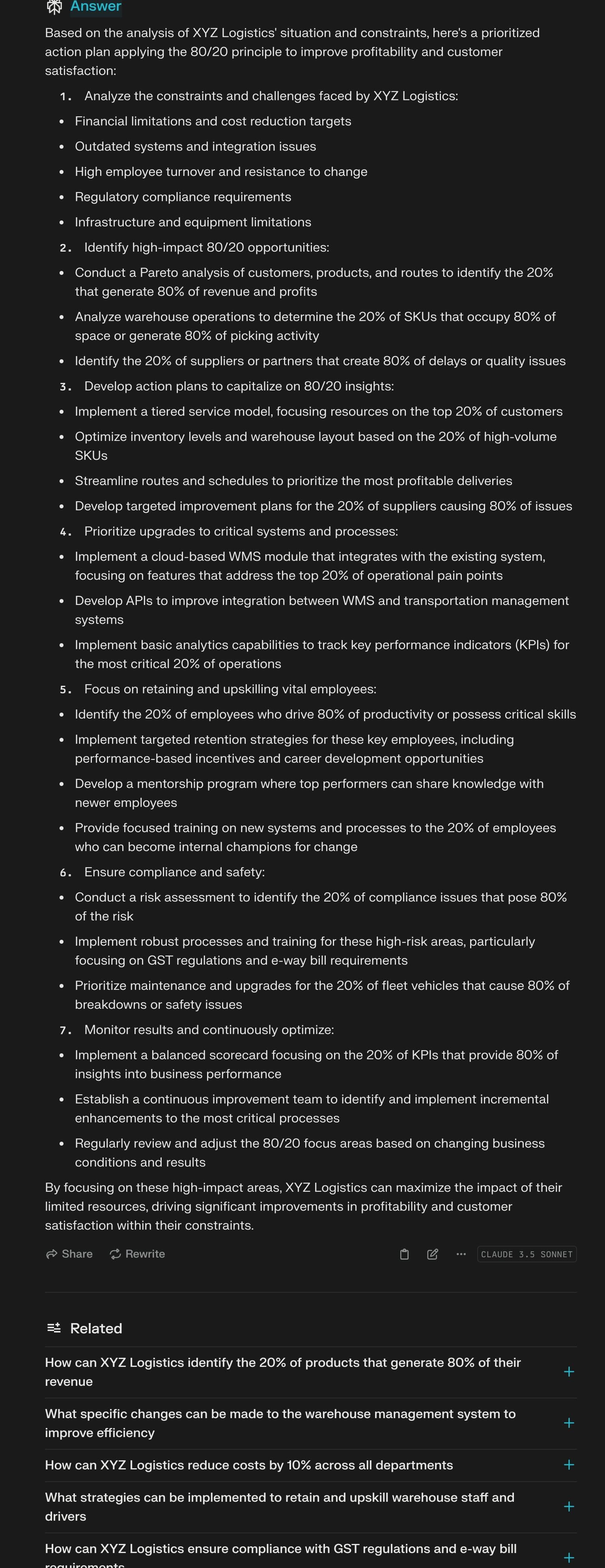
Your task is to analyze the company’s situation and constraints, and develop a prioritized action plan to apply the 80/20 principle to improve profitability.
[Structure] =
- Analyze the constraints and challenges faced by XYZ Logistics
- Identify high-impact 80/20 opportunities
- Develop action plans to capitalize on 80/20 insights
- Prioritize upgrades to critical systems and processes
- Focus on retaining and upskilling vital employees
- Ensure compliance and safety
- Monitor results and continuously optimize
End Prompt
Prompt for 80/20 Rule Tested on Perplexity.
Notes
- To customize these prompts for your problem, start with a Product Brief, or Problem Statement
- Then change the variables in the Avatar, Topic, and Task, as appropriate.
- You can expand the points in the Structure separately using one point/ section at a time in the ChatBot.
AI Tools that you can use
The prompts on Phewture are AI tool agnostic.
They should work on GeminiPro, ChatGPT, Claude and Perplexity. Even on free tools such as llama3 by Meta which you can install on your desktop.
- ChatGPT and Gemini Pro can read Google Files by way of attachment
- Claude can read PDFs.
- Perplexity can read text files and PDFs.
Use these capabilities to upload your prompts and get the best out of these tools.
Next Steps
- To help you find your way around Phewture, I have put together a set of AI Recipes under Wayfinding. Do go through these and you’ll navigate like a pro through this stream of consciousness. 😄
- The Learning Methods are exercises that I’d recommend if you wish to wrap your head around the possibilities of using AI Recipes at work, or for play.
- Don’t forget to leave your comments below and share your joy with your friends on social media. Use the share icons below this post to gain some good karma.
Wish to train your in-house team on AI techniques?

Phewture offers AI-spurred training for teams. Do check out the Training Services.
While you enjoy your sojourns here, I’d love to have your feedback. Use the comment box below and let it rip.