

Introduction
Forget the crystal ball and tarot cards. Intuitive thinking is your real-life business superpower.
It’s that gut feeling, that little voice inside, that tells you what to do without a PowerPoint presentation to back it up.
In today’s fast-paced, data-driven world, tapping into your intuition can give you a serious edge.But how do you harness this mysterious force?
I’ve got your step-by-step guide to unleashing your inner intuitive genius, complete with prompts to get those Spidey senses tingling.
We’ll explore how intuition can help you innovate, make snap decisions, and boost your business mojo.
First up, the opportunities. Need to pivot on a dime? Intuition to the rescue.
Trying to read a client’s mind? Channel that inner psychic.
Want to spot the next big trend before your competitors? Let your gut be your guide.
But wait, there’s more. I’ve got a special AI-powered recipe to supercharge your intuition. It’s like having a personal intuition coach in your pocket.
Just follow the steps, add a dash of machine learning, and watch your intuitive powers grow.
So put away the spreadsheets and let your intuition take the wheel.
With these tools and prompts at your fingertips, you’ll be making bold moves and crushing it in business like never before.
Your intuition is your secret weapon – time to let it shine.
Models for Intuitive Thinking
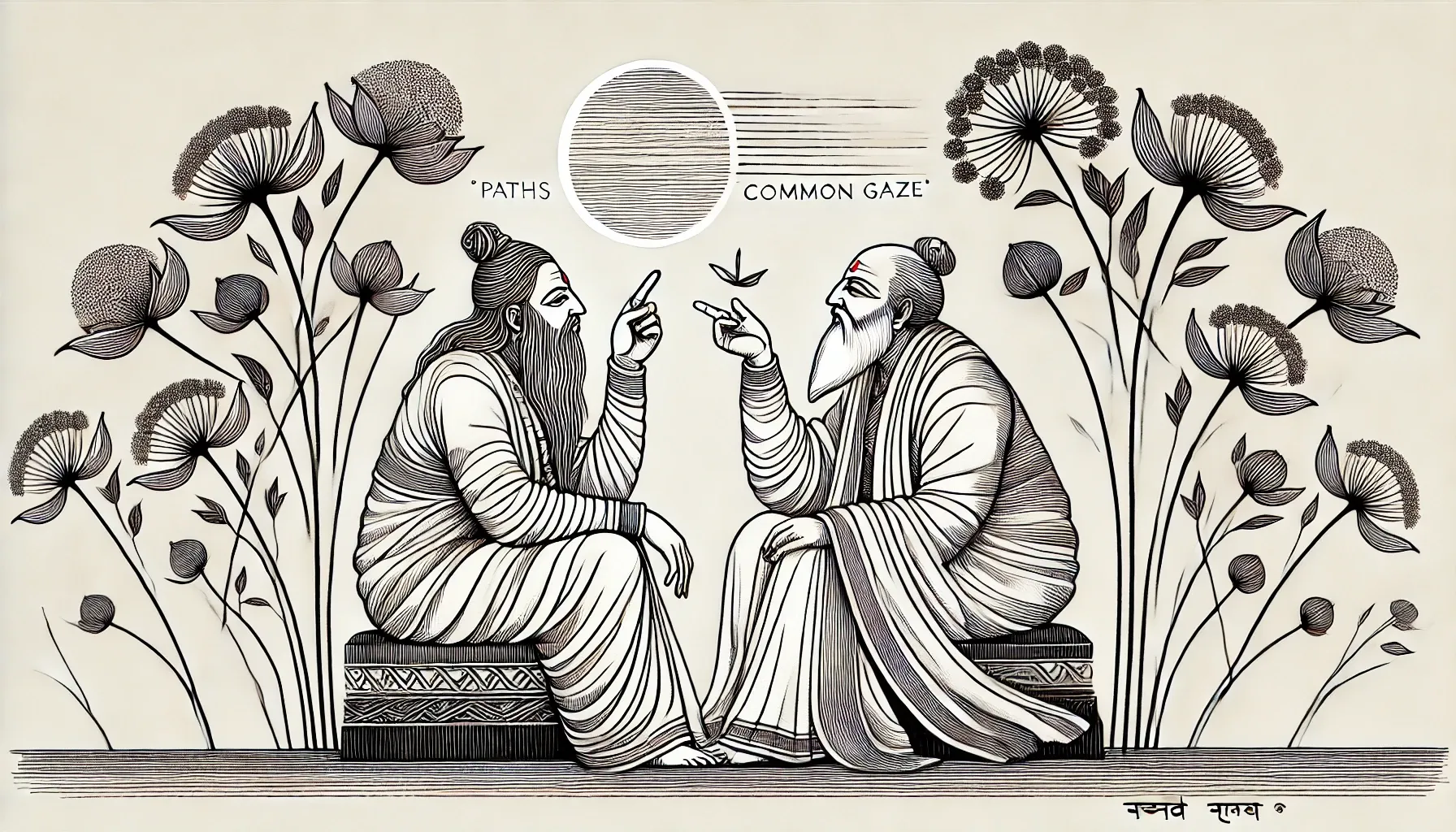
There are 5 models in Intuitive Thinking:
- Heuristics
- Thin-Slicing
- Insight
- Naturalistic Decision Making
- Empathic Accuracy
Let’s explore each one in detail with prompts.
Heuristics
These are your brain’s secret cheat codes for swift decision-making in a chaotic world.
These mental shortcuts help you leap to “good enough” conclusions without getting bogged down in analysis paralysis.
Heuristics are your multipurpose tool for cutting through complexity. Just watch out for those sneaky cognitive biases lurking in the shadows!
Now let’s create prompts for the six disciplines.
Marketing Managers
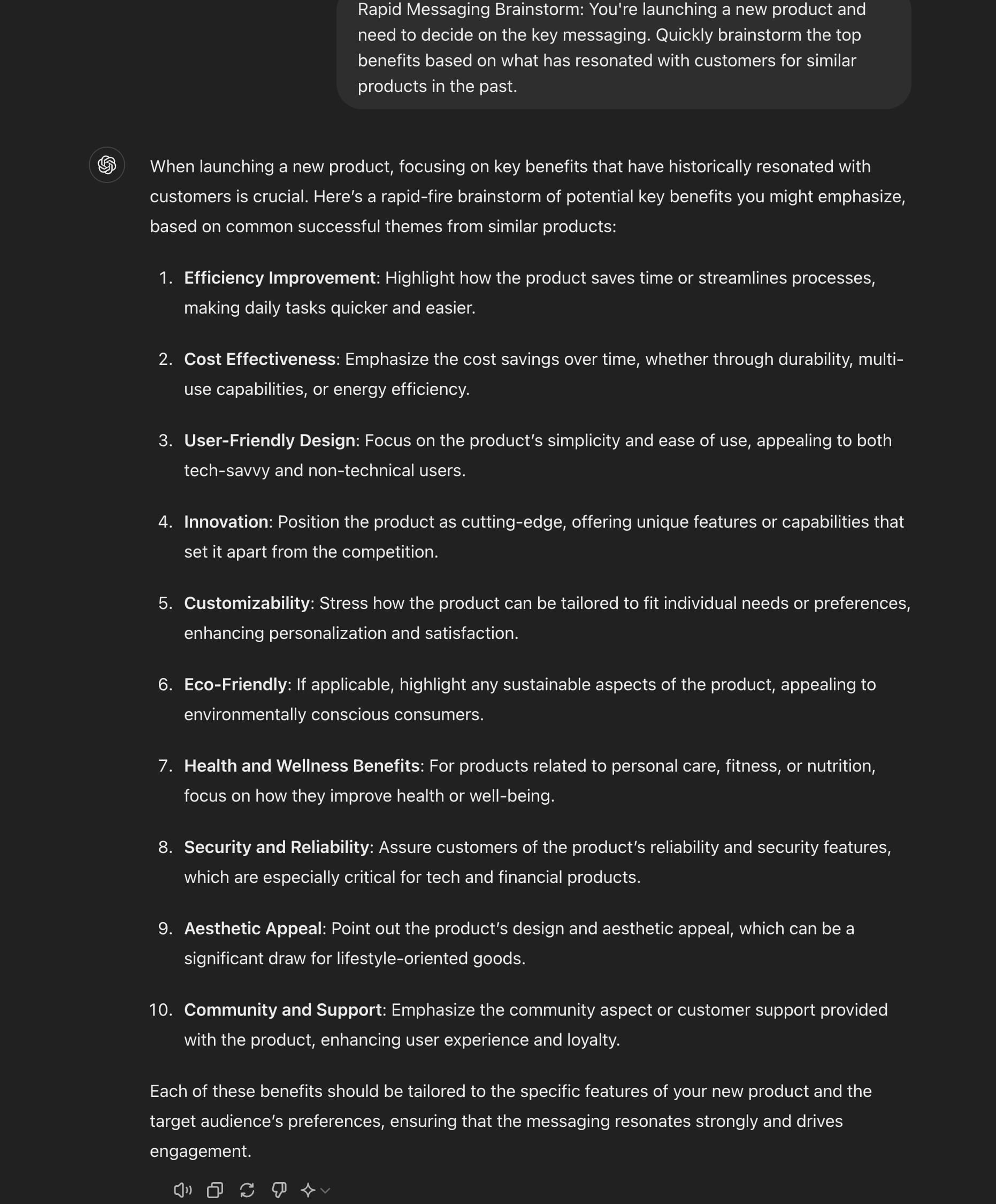
- Rapid Messaging Brainstorm: You’re launching a new product and need to decide on the key messaging. Quickly brainstorm the top benefits based on what has resonated with customers for similar products in the past.
Let’s check what we get with this Rapid Messaging Brainstorm prompt in ChatGPT Plus.
- Gut Check Sponsorship Decision: A last-minute opportunity arises to sponsor a major event. Decide if it’s worth pursuing based on your gut feeling about the event’s alignment with your brand, without doing a full analysis.
- Agency Partner Selection Shortcut: You’re choosing between two advertising agencies. Pick the one that feels right based on their past campaigns for similar brands, rather than an exhaustive comparison.
Business Leaders
- Intuitive Market Expansion Choice: You need to make a quick decision on whether to pursue a new market. Rely on your intuition about the market’s potential based on past expansions into similar markets.
- Rapid Crisis Response Planning: A crisis hits your industry. Rapidly devise a response plan based on what worked for your company during a previous crisis, without extensive scenario planning.
- Gut Feel Partnership Pick: You’re considering two potential business partnerships. Go with your gut on which partner seems more trustworthy and capable, rather than an in-depth due diligence process.
Creative Professionals
- Rapid Logo Concept Sketching: You’re designing a logo for a new client. Sketch some initial concepts based on successful logos you’ve designed for similar brands in the past.
- Intuitive Color Palette Selection: You need to choose a color palette for a project. Quickly decide based on color schemes that have worked well for similar projects, without researching color theory.
- Mashup Campaign Idea Generation: You’re brainstorming ideas for a campaign. Rapidly generate concepts by combining elements from your most successful past campaigns in new ways.
Content Creators
- Gut Feel Topic Selection: You need to choose a topic for your next blog post. Pick a subject that has generated high engagement for similar posts in the past, without doing keyword research.
- Proven Format Choice: You’re deciding on the format for a new piece of content. Go with a format that has performed well for your audience in the past, like a listicle or how-to guide.
- Headline Modeling Exercise: You need to write a catchy headline. Brainstorm options by modeling past high-performing headlines from your own content and competitors.
Entrepreneurs
- Intuition-Driven Pivot Decision: You’re considering pivoting your startup’s focus. Make the call based on your intuition about which direction has the most potential, without extensive market analysis.
- Culture Fit Hiring Shortcut: You need to hire a key team member quickly. Choose the candidate that feels like the best culture fit based on past hires, rather than a long interview process.
- Gut Check Funding Opportunity: You’re deciding whether to pursue a new funding opportunity. Go with your gut feeling about the investor’s reputation and track record, without extensive research.
Product Managers
- Rapid Feature Prioritization: You’re prioritizing features for your product roadmap. Quickly rank them based on what has driven user engagement for past features.
- Intuitive Pricing Decision: You need to decide on pricing for a new product. Choose a price point based on what has worked for similar products in your portfolio, without in-depth market research.
- Proven Onboarding Flow Selection: You’re choosing between two user onboarding flows. Pick the one that aligns with onboarding best practices you’ve seen work for similar products.
Thin-Slicing
Like a mental samurai, you slice through the noise to find the signal.
With razor-sharp intuition, you zero in on the essential details that matter, filtering out the rest.
Thin-slicing is your superpower for making spot-on snap judgments, reading between the lines, and finding the truth in the blink of an eye.

Let’s understand how professionals in marketing, business, creative, content, entrepreneurship and product management can use thin slicing to their advantage.
Marketing Manager
- Rapid Campaign Assessment: Glance at a competitor’s ad for 5 seconds. Jot down your instant impressions about the key message, target audience, and expected impact.
- Lightning Customer Review: Scan 3 customer reviews for a new product. Highlight the main themes and predict how they will influence sales.
- Snap Trend Spotting: Scroll a popular industry hashtag for 1 minute. Note any emerging trends or hot topics to leverage in your content.
Business Leaders
- Quick Culture Read: Observe a team meeting for 2 minutes. Gauge the level of engagement, collaboration, and leadership dynamics.
- Rapid Competitor Scan: Skim a rival’s annual report. Identify their top priorities, strengths, and vulnerabilities for the coming year.
- Snap Talent Assessment: Review a candidate’s resume for 30 seconds. Highlight the key experiences and traits that indicate their potential fit and value.
Creative Professionals
- Instant Brand Audit: Look at a brand’s homepage for 10 seconds. Capture your immediate reactions to the visual style, personality, and positioning.
- Rapid Creative Review: Flip through a colleague’s sketches or storyboards. Provide gut feedback on the big idea, execution potential, and areas to refine.
- Quick Inspiration Hit: Spend 1 minute in a new environment, like a store or street. Note 3 things that spark fresh ideas to explore in your work.
Content Creators
- Snap Audience Pulse: Read the titles of the 5 latest posts on a popular blog. Grasp what topics are resonating and why.
- Rapid Voice Check: Skim an influencer’s social feed for 30 seconds. Characterize their unique tone, style, and audience engagement approach.
- Lightning Research Recap: Speed read a new study in your field. Distill the 3 most compelling stats or insights to feature in your content.
Entrepreneurs
- Quick Pitch Test: Give your startup pitch to a stranger in 30 seconds. Note their instant questions, reactions, and level of interest to refine your hook.
- Rapid Market Scan: Spend 5 minutes on a top industry news site. Spot the most pressing customer needs and emerging players to watch.
- Snap Investor Impression: Glance at a VC’s portfolio page. Determine their key investment themes and criteria to tailor your outreach.
Product Managers
- Instant User Test: Watch a user engage with your product for 1 minute. Observe their natural behaviors, hesitations, and delights for improvement ideas.
- Rapid Roadmap Check: Review your roadmap at a glance. Confirm the features align to the top user problems and business goals.
- Quick Competitive Feature Scan: Try a competing product for 5 minutes. Identify the key features and experiences that stand out as better, worse, or different from yours.
Insight
Eureka! That lightbulb moment when the puzzle pieces suddenly click into place.
Insight is your mind’s way of leaping from confusion to clarity in a single bound.
Like a bolt of mental lightning, it strikes when you least expect it, illuminating the solution that was hiding in plain sight all along. Aha!

Marketing Managers
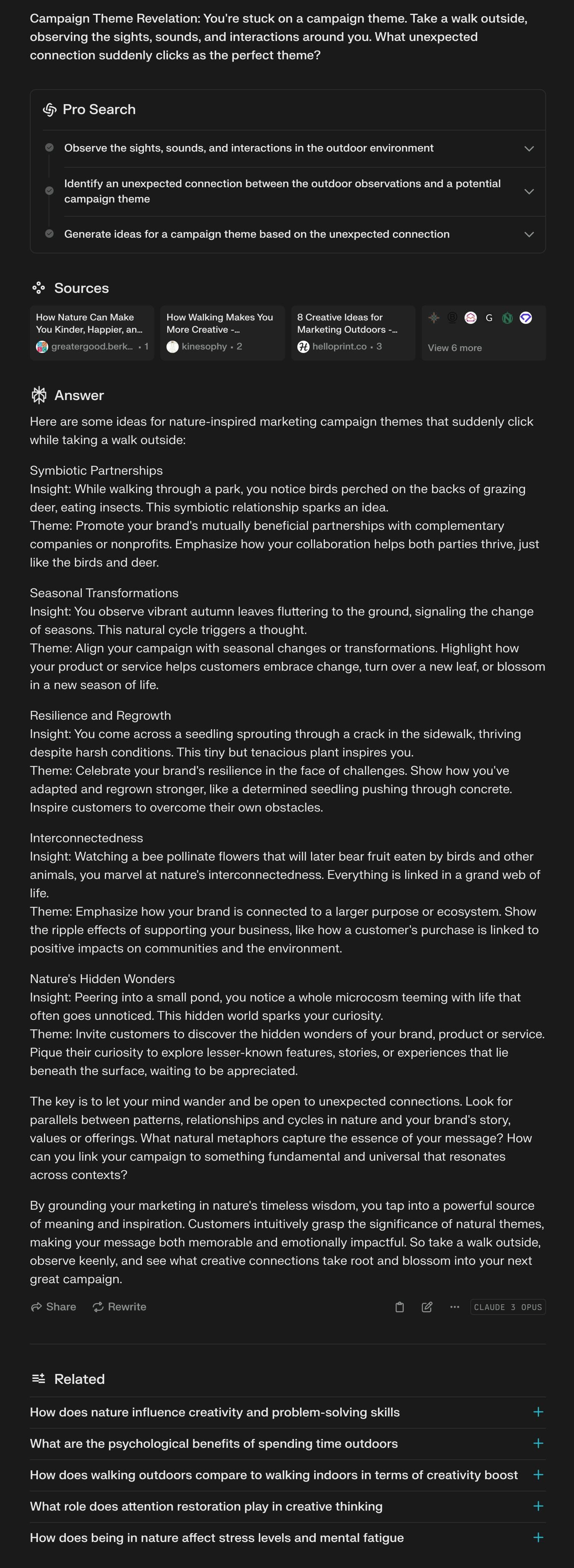
- Campaign Theme Revelation: You’re stuck on a campaign theme. Take a walk outside, observing the sights, sounds, and interactions around you. What unexpected connection suddenly clicks as the perfect theme?
Let’s try this campaign theme prompt in Perplexity and see what we get.
- Customer Insight Epiphany: Frustrated by low engagement, you decide to call 3 customers directly. During the conversations, what sudden realization about their true needs shifts your entire approach?
- Viral Trigger Aha: Brainstorming viral campaign ideas, you randomly flip through a magazine. What quirky article or ad suddenly sparks an unconventional viral concept?
Business Leaders
- Market Opportunity Eureka: In a boring budget meeting, your mind wanders to your customers’ lives. What problem do you suddenly realize your company is uniquely positioned to solve?
- Partnership Potential Epiphany: Attending an industry conference, you strike up a casual conversation with another exec. What hidden synergy between your companies suddenly becomes apparent?
- Efficiency Insight Flash: Reviewing a complex process map, your eyes glaze over. As your mind drifts, what step do you suddenly realize could be automated or eliminated?
Creative Professionals
- Design Solution Revelation: Struggling with a design challenge, you doodle aimlessly. What accidental sketch suddenly reveals an elegant solution?
- Storytelling Aha Moment: Blocked on a campaign story, you people-watch at a café. What overheard conversation fragment suddenly inspires a fresh narrative?
- Creative Mashup Epiphany: Mindlessly scrolling your social feeds, you see two unrelated posts juxtaposed. What unexpected combination suddenly sparks a brilliant creative concept?
Content Creators
- Topic Twist Insight: Staring at a blank page, you take a break to read a random Wikipedia article. What fascinating tidbit suddenly sparks a unique angle for your piece?
- Hook Aha Moment: Struggling to start a post, you free-write about your weekend. What personal anecdote suddenly emerges as the perfect opening hook?
- Clarity Epiphany: Lost in research rabbit holes, you step back and ask, “What’s the one thing I want readers to remember?” What sudden answer becomes your guiding north star?
Entrepreneurs
- Pivot Point Realization: Frustrated by stagnant growth, you visit a completely different industry’s tradeshow. What surprising parallel do you draw that reveals a new direction for your startup?
- Untapped Niche Insight: Scrolling Twitter, you see the same complaint from multiple users. What underserved need do you suddenly spot as a blue ocean opportunity?
- Monetization Aha Moment: Combing through user reviews, a recurring request stands out. What premium feature or service can you suddenly envision to boost revenue?
Product Managers
- Feature Aha Moment: Observing users struggle with your product, you suddenly empathize with their perspective. What key feature becomes glaringly obvious to prioritize next?
- UX Insight Flash: Trying a competitor’s onboarding, a confusing step trips you up. What UX tweak to your own flow suddenly becomes clear?
- Customer Job Revelation: Interviewing customers, you probe into their deeper goals. What surprising job-to-be-done emerges as the key to aligning your roadmap?
Naturalistic Decision Making
In the heat of the moment, when the pressure is on and time is short, you don’t have the luxury of deliberation.
Naturalistic decision making is your ace in the hole, allowing you to draw on your hard-earned expertise to make the right call, right now.
It’s like having a sixth sense for navigating high-stakes situations with cool-headed confidence.

Marketing Managers
- Rapid Response Pivot: Midway through a major event, your keynote speaker cancels. Drawing on past experience, what quick program change do you make to keep attendees engaged?
- Social Media Firestorm Instinct: A misinterpreted tweet sparks outrage. Trusting your gut, what swift action do you take to quell the backlash and restore brand reputation?
- Influencer Fallout Reflex: Minutes before launch, your celebrity influencer is caught in a scandal. Relying on hard-earned wisdom, how do you rapidly adjust your campaign?
Business Leaders
- Snap Layoff Judgment: Amid a financial crisis, you must suddenly downsize. Drawing on past tough calls, which departments do you intuitively protect and which do you cut?
- Rapid Merger Verdict: A surprise acquisition offer lands on your desk. Harkening back to previous deals, what key factors guide your quick go/no-go decision?
- Snap Strategy Shift: Breaking news reveals your biggest competitor’s game-changing move. Filtering this intel through your experience, what bold countermeasure do you swiftly set in motion?
Creative Professionals
- Gut-Check Creative Decision: A client hates your designs just hours before the pitch. Banking on your battle-tested instincts, which brave concepts do you choose to salvage and sell in?
- Rapid-Fire Art Direction: On a hectic photoshoot, your photographer’s losing control. Channeling your deep expertise, what quick guidance do you give to nail the shot?
- Pressure-Cooker Copy Judgment: With minutes to press time, your headline feels off. Drawing on your wordsmithing sixth sense, what punchy rewrite do you fire off?
Content Creators
- Breaking News Instinct: A late-breaking story changes your article’s angle. Tapping into your journalistic reflexes, how do you quickly pivot your narrative?
- Trending Topic Reflex: A sudden spike in search trends demands fresh content. Relying on your well-honed news sense, what timely spin do you rapid-fire publish?
- Comment Section Judgment Call: A flame war erupts in your comments. Sifting through the noise with a seasoned eye, which posts do you intuitively delete vs. engage?
Entrepreneurs
- Investor Curveball Instinct: Mid-pitch, an investor throws you an unexpected hardball. Thinking on your feet, how do you spontaneously flip the script in your favor?
- Snap Hiring Decision: A critical role opens up days before a big deadline. Scanning your network with a practiced eye, who do you swiftly tap as the perfect fit?
- Gut-Check Pivot: Weeks from launch, user tests signal low demand. Sifting this data through your founder spidey sense, what quick product pivot do you green-light?
Product Managers
- Rapid Re-Prioritization: Sales is screaming for a new feature. Weighing this against your battle-tested roadmap, what’s your snap keep/cut/defer decision?
- Pressure-Cooker Pricing Verdict: Finance demands you raise prices, but your gut says it’s too soon. Filtering their rationale through your hard-won wisdom, where do you draw the line?
- Snap Scope Judgment: Engineering says a key feature won’t ship on time. Drawing on your past estimation prowess, what rapid scope cut feels right to keep the train on the tracks?
Empathic Accuracy
You’ve got a PhD in reading people. With uncanny sense, you can tune into the unspoken thoughts and feelings simmering beneath the surface.
Empathic accuracy is your secret weapon for understanding what makes people tick, anticipating their needs, and building rapport.
It’s like having a supercharged emotional antenna that picks up on all the subtle signals others miss.

Marketing Managers
- Focus Group Whisperer: Observing a focus group from behind the glass, tune into the subtle facial expressions and body language cues that reveal participants’ true feelings about your product.
- Customer Review Decoder: Reading between the lines of customer reviews, what unspoken desires, fears or aspirations can you intuit that could inspire your next campaign?
- Sales Call Sage: Listening in on a sales call, can you detect the exact moment the prospect’s interest is piqued, even before they voice it? What subtle shift in tone or energy tips you off?
Business Leaders
- Boardroom Empath: In your next executive meeting, close your eyes and “feel into” the room. Whose unspoken doubts or concerns can you sense simmering beneath the surface?
- Negotiation Intuiter: Across the bargaining table, tune into your counterpart’s micro-expressions and mannerisms. What hidden motives or pressure points can you discern?
- Employee Whisperer: Walking the halls, pay attention to the subtle emotional undercurrents in your team’s interactions. What unvoiced tensions or triumphs can you pick up on?
Creative Professionals
- Client Mind Reader: Presenting creative concepts, watch your clients’ faces closely. Can you predict their feedback before they give it, based on their subtle reactions?
- Collaborator Interpreter: Brainstorming with your team, sense the ideas that spark excitement or fall flat, even before anyone speaks. What’s the “energy vote” telling you?
- Audience Intuiter: Reviewing campaign analytics, look beyond the numbers. What deeper audience sentiments and motivations can you glean from the data patterns?
Content Creators
- Reader Whisperer: Scanning comments on your latest post, what can you read between the lines? What unspoken questions, objections or aha moments are hidden in the subtext?
- Interviewee Interpreter: Conducting an interview, listen for the meaning behind your subject’s words. What unspoken emotions or stories can you draw out with your questions?
- Trend Empath: Scrolling through social feeds, what collective yearnings or fears can you sense percolating, before they bubble up into the zeitgeist? What content will resonate?
Entrepreneurs
- Investor Intuiter: Pitching to VCs, tune into the subtle skepticism or excitement behind their poker faces. How can you pivot your pitch to address their unvoiced concerns?
- Customer Whisperer: Shadowing sales calls, what unmet needs or frustrations can you intuit from customers’ tone and word choice? What product tweaks will delight them?
- Market Empath: Poring over industry news and reports, what shifts in market sentiment can you sense in the tea leaves? Where is the “smart money” moving before the herd?
Product Managers
- User Whisperer: Watching user testing, look beyond what participants say. What do their hesitations, confused looks or delighted grins reveal about their true experience?
- Stakeholder Mind Reader: Gathering requirements from across the org, read between the lines of each team’s “asks”. What unspoken priorities or politics underlie their position?
- Dev Team Empath: Attending standup, tune into the emotional pulse of your engineers. Beneath the jargon and stoicism, what subtle friction or enthusiasm can you feel?
All The Intuitive Thinking Techniques Applied
To One Marketing Problem

Problem: Launch a New Product Line
A consumer goods company is considering launching a new line of eco-friendly cleaning products.
The marketing team can use intuitive thinking techniques to guide their decision-making process:
To gauge the viability of this idea, the marketing team can use the following ideas.
Thin-Slicing
- Market trends: The team notices the growing consumer demand for sustainable, non-toxic household products.
Reports show double-digit growth in the eco-friendly cleaning segment over the past 3 years, indicating a promising opportunity.
- Competitor analysis: A quick scan of leading competitors reveals a gap in the market for premium, plant-based cleaning formulas that are both highly effective and environmentally safe.
Most existing green brands focus on either performance or sustainability, but few successfully combine both.
- Target audience insights: Prior research on the company’s target demographic (health-conscious millennials) shows a strong preference for brands that align with their values.
78% of this cohort are willing to pay more for eco-friendly products that don’t compromise on quality.
- Retail landscape: The team identifies a short list of potential retail partners known for championing sustainable brands, such as Whole Foods and Target’s “Clean Living” section.
These retailers have a proven track record of successfully launching green product lines to mainstream audiences.
- Supply chain feasibility: A brief review confirms the company has existing relationships with packaging and raw material suppliers who offer sustainable options that would meet the eco-friendly criteria for this new line.
By quickly piecing together these key data points, the team can intuitively assess that this new product line has strong potential. The combination of favorable market trends, a competitive white space opportunity, and alignment with target audience preferences suggests a high likelihood of success,
While additional validation will be needed, this Thin-Slicing exercise provides an efficient initial screen to green-light further exploration of the concept.
Heuristics
The marketing team can draw on their past experiences with successful product launches to identify proven strategies for the new eco-friendly line. For example:
- Pricing: Premium positioning with a 20-30% markup over conventional cleaning products has worked well for past sustainable brand launches.
- Distribution: Focusing on specialty retailers like Whole Foods and online channels such as Amazon’s Launchpad program has been effective for reaching eco-conscious consumers.
- Promotions: Tactics like social media influencer partnerships, product demos, and trial-size offerings have driven strong trial and adoption rates for new product introductions.
By applying these heuristics, the team can efficiently develop a go-to-market plan that leverages best practices from previous successes.
Insight
To generate creative ideas for the new product line, the team can use brainstorming techniques like lateral thinking and random word association. For instance:
- Packaging design: The team could challenge themselves to think of unconventional materials beyond just recycled plastic, such as biodegradable hemp or bamboo.
- Product features: By randomly pairing the product with unrelated words like “yoga” or “meditation,” the team might devise a unique aromatherapy-inspired scent line that promotes relaxation while cleaning.
- Marketing campaign: The team could brainstorm ways to gamify eco-friendly cleaning, such as a mobile app that rewards users for sustainable habits and lets them compete with friends.
These creative exercises help the team push past obvious ideas and uncover differentiated solutions that can set the new line apart.
Empathic Accuracy
To deeply understand target consumers’ needs and preferences, the team can conduct immersive research like:
- In-home observations: Watching how consumers actually use cleaning products in their homes can yield insights into pain points and unmet needs that surveys might miss.
- Empathy interviews: Having in-depth conversations with consumers about their cleaning routines, motivations, and aspirations can uncover emotional drivers to inform branding and messaging.
- Co-creation sessions: Inviting consumers to participate in product development and provide feedback on early concepts can ensure the line resonates with their values and lifestyles.
By building empathy for the target audience, the team can intuitively design products and experiences that exceed expectations and forge strong brand connections.
Naturalistic Decision Making
As the launch date nears, the team will need to make quick, confident decisions to keep the project on track. For example:
- When a key supplier experiences a delay, the team might need to rapidly evaluate alternative options and choose the best path forward to minimize disruption.
- If initial sales in a pilot market are lower than expected, the team may need to swiftly adjust messaging or promotional tactics based on their intuition of what’s not resonating with consumers.
- When a last-minute regulatory change requires a formula modification, the team will have to decide how to comply without compromising product efficacy or sustainability.
In these high-pressure situations, the team can rely on their experience, judgment, and intuition to make sound decisions that keep the launch on course.
Conclusion
As you’ve seen, intuitive thinking is a powerful tool that can complement your analytical approaches in business settings.
By understanding and cultivating this skill, you can make faster, more holistic decisions, especially in complex or ambiguous situations.
From marketing and product development to strategic planning and crisis management, your intuition plays a crucial role in driving success.
You can apply techniques like thin-slicing, heuristics, and empathic accuracy to real-world problems, yielding innovative solutions and insights.
By embracing intuitive thinking and balancing it with data-driven analysis, you can navigate challenges more effectively, foster creativity, and stay ahead in an ever-changing landscape.
AI Recipe For Intuitive Thinking
Caveats
- You can use this recipe to combine all the techniques in Intuitive Thinking in one go.
- For doing this, we shall use the RATS Framework, an elegant method I have developed for writing prompts. It provides the context clues and structure to help GPTs frame and answer problems.
- Before using RATS prompts, ensure you have clearly defined the problem and constraints using the Problem Statement or Product Brief Methods from Phewture.
- If this this your first foray on Phewture, do familiarize yourself with the Basics of Prompting.
Begin Prompt
[Role] =
Act as an intuitive thinking expert with expertise in the following areas: Recognizing patterns and applying heuristics from past experiences. Empathizing with target audiences to understand their needs and preferences. Generating creative ideas and insights through brainstorming and lateral thinking. Making quick, informed decisions in high-pressure situations. Collaborating with cross-functional teams to bring new products to market successfully
[Avatar] =
The target audience for this initiative is:
- Marketing managers and product development teams in consumer goods companies
- Entrepreneurs and startup founders looking to launch new products or services
- Business leaders seeking to foster a culture of innovation and intuitive decision-making
[Topic] =
Launch a new line of eco-friendly cleaning products using intuitive thinking techniques [modify as needed]
[Task] =
Generate ideas for successfully launching the new product line by applying intuitive thinking techniques [modify as needed]
[Structure] =
Idea Generation // Attempt each method using a query separately as shown below, for the same problem.
Thin-Slicing: Quickly assess the potential success of the new product line based on a few key pieces of information, such as market trends, competitor offerings, and consumer preferences for sustainable products. Show 5 scenarios.
Query 2
[Task] = Generate ideas for successfully launching the new product line by applying the intuitive thinking technique shown below:
Heuristics: Apply past experiences with successful product launches to identify patterns and best practices that could apply to this new line, such as effective pricing strategies, distribution channels, and promotional tactics. Use 5 scenarios.
Query 3
[Task] = Generate ideas for successfully launching the new product line by applying the intuitive thinking technique below:
Insight: Through brainstorming sessions and creative exercises, tap into the team’s collective intuition to generate novel ideas for product features, packaging design, and marketing campaigns that would resonate with the target audience.
Explain 5 scenarios.
Query 4
[Task] = Generate ideas for successfully launching the new product line by applying the intuitive thinking technique below:
Empathic Accuracy: Conduct focus groups and user testing to intuitively gauge consumers’ reactions to product prototypes, branding, and messaging. Observe participants’ body language and emotional responses to refine the product line and better meet customer needs and preferences. Use 5 scenarios.
Query 5
[Task] = Generate ideas for successfully launching the new product line by applying the intuitive thinking technique below
Naturalistic Decision Making: As the launch date approaches, make quick decisions based on limited information, such as adjusting the product mix or modifying the marketing budget. Trust intuition and draw on past experiences to navigate challenges and adapt the strategy in real-time. Show 5 scenarios.
End Prompt
AI Tools that you can use
The prompts on Phewture are AI tool agnostic.
They should work on GeminiPro, ChatGPT, Claude and Perplexity. Even on free tools such as llama3 by Meta which you can install on your desktop.
- ChatGPT and Gemini Pro can read Google Files by way of attachment
- Claude can read PDFs.
- Perplexity can read text files and PDFs.
Use these capabilities to upload your prompts and get the best out of these tools.
You will have to use the following prompt, if you follow the file upload method: Please complete the tasks outlined in the attached document.
Next Steps
- To help you find your way around Phewture, I have put together a set of AI Recipes under Wayfinding. Do go through these and you’ll navigate like a pro through this stream of consciousness. 😄
- The Learning Methods are exercises that I’d recommend if you wish to wrap your head around the possibilities of using AI Recipes at work, or for play.
- Don’t forget to leave your comments below and share your joy with your friends on social media. Use the share icons below this post to gain some good karma.
Wish to train your in-house team on AI techniques?

Phewture offers AI-spurred training for teams. Do check out the Training Services.
While you enjoy your sojourns here, I’d love to have your feedback. Use the comment box below and let it rip.