

What is Lateral Thinking?
Lateral thinking is a method of problem-solving that encourages looking at problems from new and unique angles.
Unlike traditional, linear thinking which follows a direct and logical path, lateral thinking involves breaking away from established patterns to generate innovative ideas.
This approach is about changing perception and understanding with creativity, rather than merely applying standard logic.
Where Can You Use Lateral Thinking?
Lateral thinking can be applied across various disciplines of business.

In this post, we discuss 29 powerful Lateral Thinking Techniques and prompts that you can use.
Each Technique has prompt examples from the perspective of Marketing, Business, Creative, Content, Entrepreneur and Product Management.
Each prompt can be used directly on ChatGPT, Gemini Pro, Claude, or Perplexity to get results. The results may vary but you will get an output that will surprise you nonetheless.
Go on, try it out.
#1. Random Stimulation
Deliberately introduce unrelated words, objects, or images into your thinking process.
For example, open a dictionary to a random word and force connections between that word and your problem. This jolts your mind out of established patterns and can trigger unexpected associations and ideas.

Example prompts for Random Stimulation
- Marketing Manager – Random Word: “Balloon”
Imagine your marketing campaign is a hot air balloon. How can you make it rise above the noise and capture attention in a sky crowded with competitors? What unique patterns or shapes can you add to your balloon to make it impossible to ignore?Let’s see what happens when you input this prompt into say, ChatGPT?
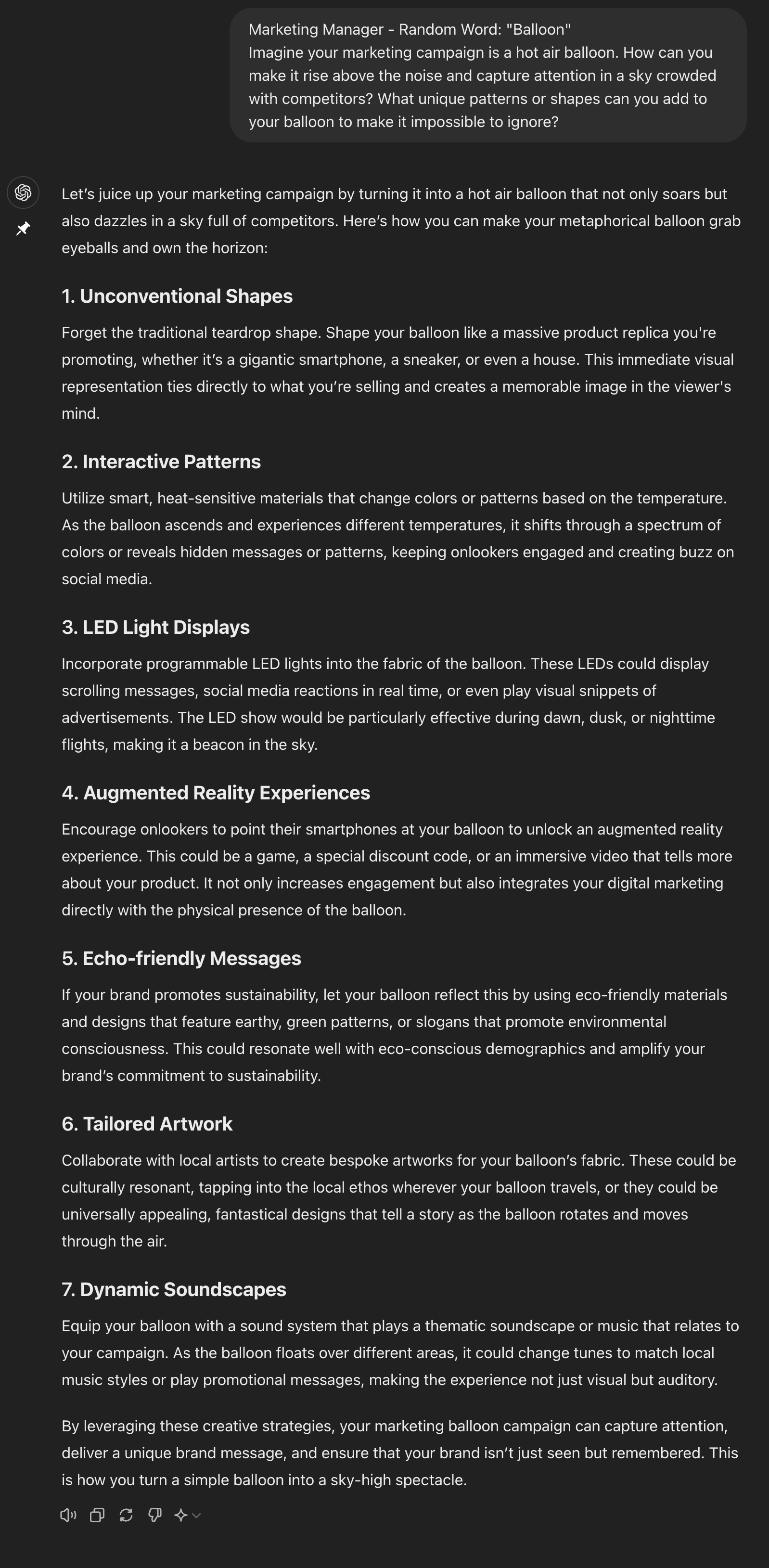
You get the drift, right? Check out the other prompts below.
- Business Leader – Random Word: “Cactus”
Your company is a cactus in a corporate desert. How can you use your prickly exterior to protect your team while still attracting the right partners? What hidden reservoirs of innovation can you tap into to thrive where others wither? - Creative Professional – Random Word: “Jellyfish”
Think of your creative process as a jellyfish. How can you harness its fluid, transparent nature to adapt to different creative currents? What unique bioluminescence can you develop to shine brightly in the depths of the creative ocean? - Content Creator – Random Word: “Igloo”
Your content strategy is an igloo in a digital blizzard. How can you construct it to provide warmth and shelter for your audience? What unique ice blocks can you use to make your igloo stand out in the vast white landscape of online content? - Entrepreneur – Random Word: “Firefly”
Consider your startup as a firefly in the night. How can you make your light not just brighter, but more intriguing to attract investors and customers? What unique pattern of flashes can you create to communicate your value proposition? - Product Manager – Random Word: “Helicopter”
Think of your product as a helicopter navigating through urban skyscrapers. How can you design it to be more maneuverable and adaptable to changing market conditions? What unique features can you add to make it the go-to choice for users in a crowded skyline of options?
#2. Provocation
Make outrageous or impossible statements related to your problem, then use those provocations as stepping stones to new ideas.
For instance, propose “Cars should drive on the ceiling” to spark fresh thinking about transportation infrastructure.
Example prompts for Provocation
Marketing Manager
Provocative Statement: “What if we stopped all digital marketing and relied solely on word-of-mouth?”
Challenge the assumption that digital marketing is essential. How would you create a buzz and drive engagement purely through organic, word-of-mouth strategies?
Business Leader
Provocative Statement: “What if we doubled our prices overnight?”
Question the belief that higher prices deter customers. How could you justify and communicate this change to enhance perceived value and maintain customer loyalty?
Creative Professional
Provocative Statement: “What if we banned all traditional art supplies?”
Disrupt the norm by eliminating conventional tools. How would you express creativity using only unconventional materials or digital mediums?
Content Creator
Provocative Statement: “What if we published only one piece of content a year?”
Challenge the idea that more content equals better engagement. How would you make that single piece so impactful and memorable that it sustains audience interest for an entire year?
Entrepreneur
Provocative Statement: “What if we gave our product away for free?”
Defy the standard business model of selling products. How could you monetize your business and create value if your main product was free?
Product Manager
Provocative Statement: “What if we removed the most popular feature from our product?”
Question the necessity of your product’s most beloved feature. How would you innovate and add new value to compensate for its absence and keep users engaged?
#3. Reversal/Backwards Thinking
Start with the end goal and work backwards, or completely invert the problem.
If trying to increase sales, consider: “How could we guarantee no one ever buys our product?”
This reversal often illuminates hidden assumptions and new approaches.

Example prompts for Reversal
Marketing Manager
Imagine your campaign has gone viral and become a cultural phenomenon. Work backwards to determine what unconventional steps led to this unexpected success. What surprising elements did you include that captured the public’s imagination?
Business Leader
Picture your company as the most admired in your industry, setting new standards for innovation and employee satisfaction. Reverse-engineer the journey: what radical decisions or counterintuitive strategies did you implement to reach this pinnacle?
Creative Professional
Envision your masterpiece hanging in a prestigious gallery, lauded for its groundbreaking approach. Retrace your creative process: what conventional rules did you break, and which unexpected inspirations did you embrace to achieve this revolutionary work?
Content Creator
Your content has sparked a global movement, inspiring millions to take action. Backtrack through your creative journey: what unique perspective or controversial stance did you take that resonated so powerfully with your audience?
Entrepreneur
Your startup has disrupted an entire industry, becoming a household name overnight. Deconstruct your path to success: what traditional business practices did you abandon, and which counterintuitive risks paid off spectacularly?
Product Manager
Your product has become indispensable, with users wondering how they ever lived without it. Reverse-engineer its development: what features did you eliminate, and which unexpected functionalities did you add that made it so revolutionary?
#4. Challenge Assumptions
Systematically identify and question all assumptions related to the problem, especially those that seem obvious or unchangeable.
Ask “Why?” repeatedly to dig deeper. This reveals limiting beliefs and opens up new possibility spaces.

Example prompts to Challenge Assumptions
Marketing Manager
Assumption: “Our target audience is always online.”
Challenge this belief: What if your audience prefers offline experiences? How would you design a marketing strategy that captivates them without relying on digital channels?
Business Leader
Assumption: “Bigger teams are more productive.”
Question this notion: What if smaller, more agile teams could achieve greater efficiency and innovation? How would you restructure your organization to maximize impact with fewer resources?
Creative Professional
Assumption: “Creativity thrives on freedom.”
Reevaluate this idea: What if constraints and limitations actually fuel greater creativity? How would you impose new boundaries to push your creative boundaries further?
Content Creator
Assumption: “More content equals more engagement.”
Challenge this perspective: What if less content, but of higher quality, could drive deeper engagement? How would you refine your content strategy to focus on impact rather than volume?
Entrepreneur
Assumption: “Success requires a unique product.”
Question this belief: What if the key to success lies in exceptional customer service rather than product uniqueness? How would you transform your business model to prioritize unparalleled service?
Product Manager
Assumption: “User feedback always leads to better products.”
Reconsider this assumption: What if relying too heavily on user feedback stifles innovation? How would you balance user input with visionary thinking to create truly groundbreaking products?
#5. Analogies
Compare your problem to something completely different but structurally similar. If tackling business growth, analyze how trees grow and spread seeds.
Look for insights that can transfer between the analogy and your original problem.
Example prompts for Analogies
Marketing Manager
Analogy: “Marketing is like gardening.”
Think of your marketing strategy as a garden. How can you cultivate your audience with the right mix of seeds (campaigns), water (engagement), and sunlight (visibility) to ensure a bountiful harvest of brand loyalty and sales?
Business Leader
Analogy: “Leading a company is like conducting an orchestra.”
Imagine your role as a business leader is to conduct an orchestra. How can you harmonize the diverse talents and departments within your company to create a symphony of success that resonates with your market?
Creative Professional
Analogy: “Creativity is like cooking.”
Consider your creative process as cooking a gourmet meal. How can you blend different ingredients (ideas) and spices (techniques) to create a dish (project) that delights and surprises your audience?
Content Creator
Analogy: “Content creation is like storytelling around a campfire.”
Think of your content as stories told around a campfire. How can you captivate your audience with tales that are engaging, memorable, and shareable, making them feel part of a close-knit community?
Entrepreneur
Analogy: “Starting a business is like climbing a mountain.”
Visualize your entrepreneurial journey as climbing a mountain. How can you prepare for the ascent, navigate the challenges, and reach the summit, all while inspiring others to join you on the climb?
Product Manager
Analogy: “Managing a product is like being a ship’s captain.”
Imagine your product as a ship navigating through uncharted waters. How can you steer it through storms (market challenges), avoid icebergs (risks), and find the best route to your destination (customer satisfaction)?
#6. Mind Mapping
Create a visual diagram with the central problem in the middle and branch out with related ideas, using colors and images.
This spatial arrangement helps reveal connections and patterns not obvious in linear thinking.
Example prompts for Mind Mapping
Marketing Manager
Create a mind map with “Customer Journey” at the center. Branch out to explore unconventional touchpoints, hidden customer emotions, and surprising influences on purchasing decisions. How can you uncover the secret pathways that lead to brand loyalty?
Business Leader
Craft a mind map with “Future-Proof Organization” as the core. Radiate outwards to explore adaptive strategies, emerging technologies, and evolving workplace cultures. What unexpected connections can you draw between seemingly unrelated trends to create a resilient business model?
Creative Professional
Design a mind map around “Inspiration Ecosystem.” Branch out to explore diverse sources of creativity – from nature’s patterns to urban chaos, from ancient myths to cutting-edge science. How can you create a self-sustaining cycle of inspiration that constantly feeds your creative process?
Content Creator
Build a mind map with “Content Ripple Effect” at its heart. Expand outwards to explore how a single piece of content can spawn multiple formats, spark conversations across platforms, and influence diverse audience segments. How can you create content that has a life of its own?
Entrepreneur
Develop a mind map centered on “Business Alchemy.” Branch out to explore how you can transmute common resources into unique value propositions. What unexpected combinations of skills, technologies, or markets can lead to golden opportunities?
Product Manager
Construct a mind map around “Product Ecosystem.” Extend branches to explore how your product interacts with users’ lives, other technologies, and even competitors’ offerings. How can you design a product that doesn’t just solve a problem, but creates a whole new habitat of user experiences?
#7. Alternative Viewpoints
Mentally put yourself in different roles or perspectives related to the problem.
How would a child approach this? An alien? Your competitors? Each viewpoint provides unique insights and ideas.
Example prompts for Alternative Viewpoints
Marketing Manager
Alternative Viewpoint: “From the eyes of a skeptical customer.”
Imagine viewing your marketing campaign through the eyes of a skeptical customer who distrusts advertising. How would you redesign your strategy to earn their trust and convert their skepticism into loyalty?
Business Leader
Alternative Viewpoint: “From the perspective of a frontline employee.”
Consider your business strategy from the viewpoint of a frontline employee who interacts with customers daily. How would you adjust your leadership approach to better support and empower them, ensuring they feel valued and motivated?
Creative Professional
Alternative Viewpoint: “From the mind of a child.”
Approach your creative project with the curiosity and wonder of a child. How would you simplify complex ideas, infuse playfulness, and see the world with fresh eyes to bring a unique and imaginative touch to your work?
Content Creator
Alternative Viewpoint: “From the shoes of a content consumer.”
Think about your content from the perspective of a busy content consumer who is bombarded with information. How would you craft your content to be not only engaging and valuable but also easily digestible and memorable?
Entrepreneur
Alternative Viewpoint: “From the angle of a potential investor.”
Evaluate your business idea from the standpoint of a potential investor looking for the next big opportunity. How would you present your vision, demonstrate growth potential, and address risks to convince them to invest in your venture?
Product Manager
Alternative Viewpoint: “From the experience of a first-time user.”
Examine your product through the lens of a first-time user who is unfamiliar with its features. How would you simplify the onboarding process, enhance user experience, and ensure they quickly see the value and become a loyal customer?
#8. Focus Shifting
Consciously move your attention between different aspects or scales of the problem.
Zoom in on tiny details, then zoom out to the big picture. Shift between logical, emotional, and practical considerations.
This prevents fixation and enables more comprehensive solutions.

Example prompts for Focus Shifting
Marketing Manager
Shift your focus from traditional metrics to emotional impact. Instead of tracking clicks and conversions, how would you measure and maximize the joy, surprise, or inspiration your campaign brings to your audience? What unconventional methods could you use to gauge these emotional responses?
Business Leader
Move your attention from profit margins to societal impact. If your company’s success was measured solely by its positive influence on the community and environment, how would you reshape your business model? What innovative initiatives would you implement to become a force for good?
Creative Professional
Redirect your focus from the final product to the creative process itself. If the journey of creation was more valuable than the outcome, how would you transform your approach? What experimental techniques or collaborations could you explore to make the process itself a masterpiece?
Content Creator
Shift your perspective from content consumption to content interaction. How could you design your content to be not just viewed, but experienced and co-created by your audience? What innovative ways could you involve your followers in shaping the narrative?
Entrepreneur
Change your focus from scaling up to scaling deep. Instead of expanding your customer base, how could you create profound, lasting impact for a smaller group? What unique, personalized experiences or solutions could you offer to foster unwavering loyalty and advocacy?
Product Manager
Redirect your attention from feature development to problem anticipation. How could you design your product to solve problems users don’t even know they have yet? What futuristic scenarios could you envision to stay ahead of emerging needs and trends?
#9. Fractionation
Break the problem into its smallest component parts. Analyze each piece individually, then look for new ways to recombine them.
This deconstruction often reveals overlooked elements and novel recombinations.
Example prompts for Fractionation
Marketing Manager
Dissect your marketing campaign into its tiniest atoms. Examine each element separately: the color of your logo, the rhythm of your tagline, the emotion in your visuals. How can tweaking these micro-components create a macro-revolution in your brand’s impact?
Business Leader
Deconstruct your company’s success formula into its basic elements. Analyze each ingredient: team dynamics, decision-making processes, innovation pipelines. How can fine-tuning these individual gears transform your business machine into a unstoppable force?
Creative Professional
Break down your creative process into its fundamental building blocks. Scrutinize each phase: inspiration gathering, idea generation, execution, refinement. How can optimizing these individual stages turn your creative journey into a thrilling adventure of discovery?
Content Creator
Dismantle your content strategy into its core components. Examine each piece: topic selection, research methods, storytelling techniques, distribution channels. How can enhancing these separate elements combine to create a content masterpiece that captivates and converts?
Entrepreneur
Divide your startup journey into distinct milestones. Analyze each step: ideation, validation, funding, scaling. How can perfecting these individual phases transform your entrepreneurial path into a exhilarating ride to success?
Product Manager
Decompose your product into its essential features and functions. Scrutinize each aspect: user interface, core functionality, integrations, performance. How can refining these individual components elevate your product from useful tool to indispensable lifeline for your users?
#10. Escape
Physically or mentally remove yourself from the problem space entirely.
Take a walk, work on an unrelated task, or imagine you’re on a desert island.
This mental distance often allows your subconscious to make new connections, leading to “aha!” moments upon return.
Example prompts for Escape
Marketing Manager
Imagine you’re a time traveler from the year 2124, tasked with marketing a product to people in our era. How would you approach promotion when all our current marketing channels are obsolete to you? What futuristic techniques could revolutionize today’s strategies?
Business Leader
Picture yourself as the captain of a pirate ship instead of a CEO. How would you lead your crew of swashbuckling employees, navigate treacherous market waters, and uncover hidden treasure (opportunities) that others have missed? What unconventional tactics would you employ?
Creative Professional
Envision yourself as a dream architect, able to construct entire worlds in people’s minds while they sleep. How would you approach your next creative project if you could tap directly into the subconscious? What surreal elements would you incorporate to make your creation unforgettable?
Content Creator
Pretend you’re an alien tasked with explaining human culture to your home planet, but you can only use the content you create. How would you craft your message to be universally understood? What unique perspectives could you bring to everyday topics?
Entrepreneur
Imagine your startup exists in a world where money has been replaced by happiness as currency. How would you structure your business model to generate and distribute joy? What innovative “products” or “services” would you offer in this emotion-driven economy?
Product Manager
Visualize your product as a living, sentient being with its own personality and goals. How would it evolve if it could make decisions for itself? What features would it develop to better connect with users, and how might it surprise you with its choices?
#11. Random Entry
This is similar to Random Stimulation. Deliberately introduce an unrelated word, object, or concept into your thinking process.
For example, open a dictionary to a random word and force connections between that word and your problem. This jolts your mind out of established patterns and can trigger unexpected associations and ideas.

Example prompts for Random Entry
Marketing Manager
Random Entry: “Umbrella”
Imagine your marketing strategy is inspired by an umbrella. How can you create a campaign that shields your audience from the “rain” of competitors’ ads while providing a unique, colorful experience that makes them want to stay under your brand’s umbrella?
Business Leader
Random Entry: “Volcano”
Think of your business as a volcano. How can you harness the explosive energy of innovation to disrupt your industry and create new opportunities? What measures can you take to ensure this eruption leads to growth rather than chaos?
Creative Professional
Random Entry: “Mirror”
Consider your creative project as a mirror. How can you reflect the diverse perspectives and emotions of your audience in your work? What unique angles can you use to show them something they haven’t seen before?
Content Creator
Random Entry: “Maze”
Visualize your content strategy as a maze. How can you design a path that keeps your audience engaged and curious, leading them through twists and turns to discover valuable insights and hidden gems?
Entrepreneur
Random Entry: “Compass”
Imagine your startup as a compass. How can you provide clear direction and guidance in a market full of uncertainty? What innovative features can you add to help your customers navigate their challenges and find their true north?
Product Manager
Random Entry: “Puzzle”
Think of your product as a puzzle. How can you ensure all the pieces fit together seamlessly to create a complete and satisfying user experience? What unique elements can you introduce to make the process of using your product both challenging and rewarding?
#12. Concept Extraction
Here, you identify the underlying principles or abstract ideas within specific solutions or examples.
Then apply these broader concepts to your problem in new ways. This helps you move beyond surface-level thinking to find more innovative approaches.

Example prompts for Concept Extraction
Marketing Manager
Extract the concept of “transformation” from the idea of a caterpillar becoming a butterfly. How can you apply this to your marketing strategy? Create a campaign that showcases your brand’s ability to transform customers’ lives, turning ordinary experiences into extraordinary ones.
Business Leader
Distill the concept of “symbiosis” from the relationship between bees and flowers. How can you foster mutually beneficial relationships within your organization and with external partners? Design a leadership approach that creates a thriving ecosystem where everyone’s success is interconnected.
Creative Professional
Extract the concept of “emergence” from how complex patterns arise from simple rules in nature. How can you apply this to your creative process? Develop a project that starts with basic elements but evolves into something unexpectedly complex and beautiful through iteration and interaction.
Content Creator
Derive the concept of “resonance” from how certain frequencies amplify sound waves. How can you create content that resonates deeply with your audience? Craft a content strategy that identifies and amplifies the key themes that strike a chord with your followers, creating a powerful echo chamber of engagement.
Entrepreneur
Extract the concept of “adaptation” from how species evolve to survive in changing environments. How can you build adaptability into your business model? Design a venture that can swiftly morph its offerings or approach in response to market shifts, always staying one step ahead of the competition.
Product Manager
Distill the concept of “modularity” from how LEGO bricks can create endless possibilities. How can you apply this to your product development? Create a product ecosystem where individual components can be mixed and matched, allowing users to customize their experience and continuously discover new functionalities.
#13. Exaggeration
You dramatically amplify or reduce certain aspects of your problem or potential solutions. If addressing workplace efficiency, imagine a scenario where employees work 23 hours a day, or only 1 hour.
These extremes often reveal insights about the core issues or opportunities.
Example prompts for Exaggeration
Marketing Manager
Exaggeration: “Imagine your marketing budget is infinite.”
How would you design a campaign with no financial constraints? What grand, audacious ideas could you implement to capture global attention and create an unforgettable brand experience?
Business Leader
Exaggeration: “Imagine your company has only one employee—you.”
How would you manage every aspect of the business single-handedly? What processes would you streamline, and what innovative solutions would you develop to maintain productivity and growth?
Creative Professional
Exaggeration: “Imagine you have to create a masterpiece in just one hour.”
How would you harness your creativity under extreme time pressure? What techniques and shortcuts would you use to produce a work of art that still captivates and inspires?
Content Creator
Exaggeration: “Imagine your audience is the entire population of the world.”
How would you craft content that appeals to a diverse, global audience? What universal themes and storytelling methods would you employ to ensure your message resonates with everyone?
Entrepreneur
Exaggeration: “Imagine your startup’s product must solve every problem in the world.”
How would you design a product with such an ambitious goal? What features and functionalities would you prioritize to create a solution that addresses a wide range of global challenges?
Product Manager
Exaggeration: “Imagine your product has only one feature.”
How would you make that single feature so powerful and compelling that users can’t live without it? What enhancements and refinements would you focus on to ensure it delivers maximum value and satisfaction?
#14. Wishful Thinking
Temporarily suspend all practical limitations and imagine ideal scenarios.
If solving transportation issues, envision teleportation or flying cars. This freedom often leads to breakthrough ideas that can be adapted to real-world constraints.

Example prompts for Wishful Thinking
Marketing Manager
Imagine a world where your brand’s message instantly resonates with every person who encounters it. What would your perfect campaign look like if you could tap directly into people’s emotions and desires? How would you create a marketing utopia where ads are welcomed and shared eagerly?
Business Leader
Envision a company where every employee is passionate, motivated, and working at their full potential. What would your ideal organizational culture look like if you could eliminate all workplace challenges? How would you lead in this perfect business ecosystem?
Creative Professional
Picture a realm where your creativity flows endlessly, unhindered by doubts or limitations. What masterpieces would you create if you had access to infinite resources and universal understanding? How would your art transform the world in this ideal creative landscape?
Content Creator
Visualize a platform where your content instantly reaches and deeply impacts every intended viewer. What would you create if you had guaranteed engagement and unlimited creative freedom? How would you use this dream scenario to revolutionize content consumption?
Entrepreneur
Imagine a startup ecosystem where funding is abundant, regulations are supportive, and every customer immediately grasps your vision. What groundbreaking venture would you launch in this entrepreneurial paradise? How would you change the world with this ideal business environment?
Product Manager
Envision a product that anticipates and fulfills users’ needs before they even realize them. What features would this perfect product have if technological limitations didn’t exist? How would you design the ultimate user experience in this product management utopia?
#15. Distortion
Imagine intentionally altering or misrepresenting elements of the problem or solution.
For a marketing challenge, consider promoting your product as the worst in its category. This forces you to think from completely new angles and challenge assumptions.

Example prompts for Distortion
Marketing Manager
Distortion: “Imagine your target audience lives underwater.”
How would you adapt your marketing strategy if your customers were aquatic beings? What unique channels, messages, and visuals would you use to engage an underwater audience and make your brand irresistible in this submerged market?
Business Leader
Distortion: “Imagine your company operates in zero gravity.”
How would you lead and manage a business where traditional rules of physics don’t apply? What innovative structures and processes would you implement to ensure productivity and collaboration in a weightless environment?
Creative Professional
Distortion: “Imagine you can only create art using sound.”
How would you express your creativity if visual mediums were off-limits? What unique techniques and compositions would you develop to convey your artistic vision through the power of sound alone?
Content Creator
Distortion: “Imagine your content can only be experienced through smell.”
How would you craft engaging and memorable content if your audience could only perceive it through their sense of smell? What aromatic narratives and olfactory experiences would you design to captivate and inform your followers?
Entrepreneur
Distortion: “Imagine your startup’s product must be invisible.”
How would you market and sell a product that cannot be seen? What innovative features and benefits would you highlight to convince customers of its value and utility, despite its invisibility?
Product Manager
Distortion: “Imagine your product can change shape at will.”
How would you design and manage a product that can morph into different forms? What flexible functionalities and adaptable features would you incorporate to maximize its versatility and appeal to a wide range of users?
#16. Alternatives
In this case, you generate multiple distinct approaches to implement a concept or solve a problem. For each idea produced, you immediately brainstorm how it could be done differently.
This creates a branching tree of possibilities, each potentially sparking further innovation.

Example prompts for Alternatives
Marketing Manager
Concept: “Increasing Brand Awareness”
Generate multiple ways to boost brand awareness. Could you host a series of unexpected flash mobs in major cities, create a viral social media challenge, partner with influencers for a day-in-the-life takeover, or launch a guerrilla marketing campaign with eye-catching street art? How can each idea spark even more creative strategies?
Business Leader
Concept: “Improving Employee Engagement”
Explore various methods to enhance employee engagement. Could you implement a flexible work-from-anywhere policy, organize regular team-building retreats in exotic locations, introduce a gamified rewards system, or create a mentorship program with industry leaders? How can each approach inspire further innovative ideas?
Creative Professional
Concept: “Finding New Sources of Inspiration”
Consider different ways to discover fresh inspiration. Could you embark on a creative residency in a foreign country, participate in cross-disciplinary collaborations, immerse yourself in nature for a week, or explore ancient art forms and techniques? How can each source of inspiration lead to even more unique creative endeavors?
Content Creator
Concept: “Engaging a Diverse Audience”
Think of multiple strategies to engage a diverse audience. Could you create multilingual content, host interactive live sessions, develop a series of culturally inclusive stories, or collaborate with creators from different backgrounds? How can each strategy open up new avenues for audience engagement?
Entrepreneur
Concept: “Scaling a Startup”
Generate various methods to scale your startup. Could you expand into international markets, diversify your product line, form strategic partnerships, or leverage cutting-edge technology to streamline operations? How can each method inspire additional growth strategies?
Product Manager
Concept: “Enhancing User Experience”
Explore multiple ways to improve user experience. Could you implement AI-driven personalization, conduct immersive user testing sessions, introduce a seamless multi-platform integration, or design an intuitive onboarding process? How can each enhancement lead to further innovations in user experience?
#17. Harvesting
The harvesting technique is all about selecting the most promising ideas from a brainstorming session and refining them into practical solutions.
You act as a master gardener in an orchard of creativity, carefully choosing the ripest fruits and prepare them for consumption.
This technique requires the output of brainstorming as the input.
Example prompts for Harvesting
Marketing Manager
Imagine you’ve just concluded a whirlwind brainstorming session that generated a hundred wild marketing ideas. Now, you’re an idea sommelier, tasked with selecting the finest vintage concepts. How will you sift through this vineyard of creativity, plucking the most robust and flavorful ideas? What criteria will you use to refine these raw concepts into a marketing campaign that’s aged to perfection?
Business Leader
Picture yourself as the captain of a ship that’s just fished in a sea teeming with innovative business strategies. Your net is overflowing with ideas of all shapes and sizes. How will you sort through this catch, identifying the prize fish that could feed your company’s growth? What process will you use to clean, fillet, and prepare these ideas for your team to feast upon?
Creative Professional
Envision yourself as an artistic alchemist who’s just conducted a grand experiment, resulting in a bubbling cauldron of creative concepts. Now it’s time to distill this mixture into pure creative gold. How will you separate the precious elements from the base metals? What techniques will you employ to refine and polish these raw ideas into dazzling works of art?
Content Creator
Imagine you’re a content chef who’s just hosted a potluck of ideas, resulting in a smorgasbord of potential topics and formats. Your task now is to curate the perfect content menu. How will you sample each dish, deciding which flavors will tantalize your audience’s palate? What secret ingredients will you add to transform these promising ideas into a feast of engaging content?
Entrepreneur
Picture yourself as a prospector who’s struck a rich vein of entrepreneurial ideas. Your claim is glittering with potential, but not all that glitters is gold. How will you sift through this payload, identifying the truly valuable nuggets? What techniques will you use to refine these raw ideas into a polished business model that investors can’t resist?
Product Manager
Envision yourself as the curator of a museum of future products. Your latest expedition has unearthed a trove of potential features and innovations. Now you must decide which artifacts deserve a place in your product’s showcase. How will you evaluate each discovery, determining its value to users? What process will you use to restore and enhance these ideas, transforming them into must-have product features?
#17. Treatment of Ideas
The “Treatment of Ideas” technique is all about molding concepts to fit specific organizational needs or constraints.
You act as a master tailor, adjusting and refining ideas to ensure they’re a perfect fit for the company wearing them.
Example prompts for Treatment of Ideas
Marketing Manager
Imagine your wildest marketing idea is a raw diamond. Now, you’re a master jeweler tasked with cutting and polishing it to fit perfectly into your company’s brand crown. How would you reshape this gem of an idea to sparkle within your budget constraints and align with your target audience’s expectations?
Business Leader
Picture your most ambitious business strategy as a wild stallion. Your job is to tame and train it to pull your company’s chariot without losing its spirit. How would you harness this idea’s power while ensuring it runs in harmony with your organization’s current capabilities and market position?
Creative Professional
Envision your most avant-garde concept as a shapeshifting alien. Your mission is to help it blend seamlessly into your client’s world without losing its otherworldly essence. How would you adapt its form and features to resonate with the client’s brand while still pushing creative boundaries?
Content Creator
Imagine your boldest content idea is a universal translator. Your challenge is to fine-tune it to speak your brand’s unique language across all platforms. How would you adjust its vocabulary and tone to maintain consistency with your company’s voice while still reaching diverse audience segments?
Entrepreneur
Picture your most disruptive business model as a revolutionary gadget from the future. Your task is to make it work with today’s technology and market readiness. How would you modify its features and functionality to fit current constraints while still maintaining its game-changing potential?
Product Manager
Envision your most innovative product feature as a chameleon. Your job is to help it change colors to match different user needs and market segments. How would you adapt its capabilities and interface to appeal to various customer groups while staying true to your product’s core purpose?
#18. Awareness
You develop a meta-cognitive understanding of your own thought processes.
Learn to recognize when you’re falling into habitual thinking patterns and consciously resist them.
This heightened self-awareness allows you to more easily shift into lateral thinking modes when needed.
Example prompts for Awareness
Marketing Manager
Imagine your brain is a bustling city, with thoughts zipping around like cars on a highway. How can you build new roads to unexplored neighborhoods of ideas, bypassing the usual traffic jams of conventional marketing thinking?
Business Leader
Picture your mind as an ancient library, filled with dusty tomes of business wisdom. How can you rearrange the shelves, mix up the genres, and perhaps even sneak in some comic books to shake up your leadership approach?
Creative Professional
Envision your creative process as a complex ecosystem. How can you introduce an invasive species of unconventional thinking to disrupt the established order and spark a creative revolution in your work?
Content Creator
Think of your content strategy as a well-worn path through a forest. How can you veer off this familiar trail, machete in hand, to hack through the undergrowth of unexplored content territories?
Entrepreneur
Imagine your entrepreneurial mindset as a set of tinted glasses. How can you try on different lenses – perhaps kaleidoscopic or even x-ray specs – to view market opportunities in wildly different ways?
Product Manager
Picture your product development process as a recipe you’ve cooked a thousand times. How can you radically alter the ingredients or cooking method, creating a dish that’s both familiar and excitingly new to your users’ palates?
#19. Focus
You train yourself to notice and explore aspects of a problem that others overlook.
If everyone is focused on cutting costs, shift attention to increasing value.
This technique helps you find unique angles and opportunities within familiar situations.
Example: A marketing team overlooking the importance of post-purchase customer experience in their e-commerce strategy.
Example prompts for Focus
Marketing Manager
Imagine you’re shining a spotlight on the hidden corners of your customer’s journey. What overlooked touchpoints can you illuminate to create a seamless and delightful experience? How can you focus on these often-ignored moments to turn potential pitfalls into opportunities for engagement?
Business Leader
Picture yourself as a detective, focusing your magnifying glass on the subtle nuances of your company’s operations. What minor inefficiencies or unnoticed employee contributions can you bring to light? How can you refine these aspects to enhance overall productivity and morale?
Creative Professional
Envision your creative process as a dark room, with only certain elements currently visible. How can you adjust your focus to highlight the shadows and bring hidden details into the spotlight? What new perspectives can you uncover by examining the less obvious aspects of your work?
Content Creator
Think of your content strategy as a stage production. What behind-the-scenes elements, like audience feedback or content distribution channels, can you focus on to improve the overall performance? How can you bring these background components into the spotlight to enhance your content’s impact?
Entrepreneur
Imagine your startup as a bustling city, with certain neighborhoods thriving while others are neglected. How can you shift your focus to these underdeveloped areas, identifying untapped markets or overlooked customer needs? What innovative solutions can you implement to revitalize these parts of your business?
Product Manager
Picture your product as a complex machine with many moving parts. How can you focus on the often-overlooked components, like user onboarding or customer support, to ensure the entire system runs smoothly? What improvements can you make to these hidden elements to enhance the overall user experience?
#20. Change Your Routine
Shake up your daily habits to spark creativity.
Try a new route to work, rearrange your workspace, or tackle tasks at different times.
By altering your environment and patterns, you stimulate your brain to form new neural connections, leading to fresh perspectives and innovative ideas.
Example prompts Change Your Routine
Marketing Manager
Imagine your marketing team is suddenly transported to a remote island with no technology. How would you create and execute a marketing campaign using only the natural resources available? What innovative strategies could you develop using coconuts, seashells, and tropical birds as your marketing tools?
Business Leader
Picture your company headquarters has been moved to the International Space Station. How would you adapt your leadership style and business operations to function in zero gravity? What unique opportunities could arise from running a weightless workplace?
Creative Professional
Envision that you can only communicate your ideas through interpretive dance for an entire week. How would you convey complex concepts, pitch to clients, or brainstorm with your team using only body movements? What new creative insights might emerge from this physical form of expression?
Content Creator
Imagine you’ve been challenged to create content while living as a medieval monk for a month. With no modern technology, how would you craft and share your message using only quills, parchment, and carrier pigeons? What ancient wisdom might influence your content strategy?
Entrepreneur
Picture your startup operating exclusively between 2 AM and 6 AM for a week. How would you leverage the unusual hours to stand out in your industry? What nocturnal innovations or vampire-friendly services could you develop to cater to this unique timeframe?
Product Manager
Envision that your product development team can only communicate through elaborate food dishes for a month. How would you convey product specifications, user feedback, and roadmap priorities through culinary creations? What tasty new features might you cook up in this gastronomic approach to product management?
#21. Use Limitations as a Springboard
Embrace constraints as catalysts for creativity.
When faced with limited resources or strict parameters, challenge yourself to find ingenious solutions.
These boundaries force you to think outside the box and often result in more innovative outcomes than unlimited freedom would.

Example prompts for Limitations as a Springboard
Marketing Manager
Imagine your entire marketing budget has been replaced with a single emoji. How would you craft a viral campaign using only that one tiny icon to represent your brand and message? What creative ways could you leverage this ultra-minimalist constraint to capture attention and spark engagement across platforms?
Business Leader
Picture your company can only operate for one hour each day. How would you restructure your business model to maximize productivity and impact within this extremely limited timeframe? What innovative strategies could you implement to make your “power hour” the most efficient and profitable 60 minutes in your industry?
Creative Professional
Envision you can only create using a single color – no shades, no tints, just one pure hue. How would you push the boundaries of your craft to convey depth, emotion, and complexity using this monochromatic limitation? What groundbreaking techniques could you develop to make your one-color creations stand out in a vibrant world?
Content Creator
Imagine you can only communicate using words that start with the first letter of your name. How would you craft compelling content within this linguistic constraint? What creative wordplay and storytelling techniques could you employ to keep your audience engaged despite your limited vocabulary?
Entrepreneur
Picture your startup can only accept payments in the form of handwritten IOUs. How would you build trust, track transactions, and scale your business using this old-school limitation? What innovative systems could you develop to turn this seemingly archaic constraint into a unique selling point?
Product Manager
Envision your product can only be used while standing on one foot. How would you redesign its features and user experience to accommodate this quirky balance requirement? What unexpected benefits or use cases might emerge from embracing this unusual constraint in your product development?
#22. Engage with Diverse Perspectives
Seek out collaborators from varied backgrounds, cultures, or disciplines.
Their unique viewpoints can challenge your assumptions and introduce novel approaches to problems.
This cross-pollination of ideas often leads to breakthrough solutions you wouldn’t have conceived on your own.

Example prompts for Diverse Perspectives
Marketing Manager
Imagine you’re hosting a “Marketing Melting Pot” summit where your team must collaborate with professionals from wildly different fields – a deep-sea marine biologist, a quantum physicist, a Michelin-starred chef, and a graffiti artist. How would you leverage their unique perspectives to create a groundbreaking marketing campaign for a new eco-friendly product? What unexpected insights might emerge from this diverse braintrust, and how could you translate their expertise into marketing magic?
Business Leader
Picture yourself as the conductor of a business orchestra, but instead of musicians, your ensemble consists of a retired astronaut, a kindergarten teacher, a professional poker player, and a beekeeper. How would you harmonize their diverse skills and viewpoints to compose a revolutionary business strategy? What unconventional leadership techniques might you develop to orchestrate this eclectic team towards a common goal?
Creative Professional
Envision being tasked with designing a public art installation, but you must collaborate with a team of unlikely creatives: a master watchmaker, a perfume designer, a theoretical mathematician, and a Shakespearean actor. How would you blend their unique talents and perspectives to create a multi-sensory masterpiece that challenges traditional notions of art? What innovative techniques might emerge from this unconventional creative fusion?
Content Creator
Imagine you’re producing a documentary series, but your production team is composed of a forensic archaeologist, a stand-up comedian, a professional video game streamer, and a Michelin-starred pastry chef. How would you harness their diverse expertise to craft compelling, multi-layered narratives that captivate audiences in unexpected ways? What fresh storytelling approaches might arise from this eclectic collaboration?
Entrepreneur
Picture yourself launching a startup incubator, but instead of typical mentors, your advisory board consists of a circus ringmaster, a deep-sea explorer, a master origami artist, and a retired spy. How would you leverage their unconventional wisdom and experiences to nurture innovative business ideas? What unique entrepreneurial strategies might emerge from blending these diverse perspectives?
Product Manager
Envision leading a product development team comprised of a Formula 1 pit crew chief, a Michelin-starred sushi chef, a professional Lego master builder, and a butterfly conservationist. How would you synthesize their diverse expertise to create a revolutionary product that solves an everyday problem in an entirely new way? What unexpected features or design principles might arise from this unconventional collaboration?
#23. Counterfactual Thinking
Analyze past decisions and experiences to inform current problem-solving, without dwelling on regrets.
These prompts encourage you to flex your counterfactual thinking muscles in playful, imaginative ways.
By exploring these whimsical “what ifs,” you might just stumble upon some seriously innovative ideas for your real-world challenges.
In counterfactual thinking, there are no wrong turns – only unexpected discoveries!
Example prompts for Counterfactual Thinking
Marketing Manager
Imagine your last failed campaign was actually a runaway success. How would you have capitalized on that momentum? What bold, outrageous follow-up strategies would you have implemented if you had the world’s attention? Now, how can you apply those audacious ideas to your current situation?
Business Leader
Picture a world where your biggest business blunder led to an unexpected breakthrough. What hidden opportunities did that alternate reality reveal? How would you have steered your company differently with that accidental wisdom? Now, how can you mine your real-world setbacks for similar golden insights?
Creative Professional
Envision a parallel universe where your most unconventional, “too wild” idea became a cultural phenomenon. How did that version of you nurture and evolve that concept? What creative risks did you take next? Now, how can you channel that fearless alter ego’s spirit into your current projects?
Content Creator
What if your least popular piece of content unexpectedly went viral for all the right reasons? How would you have amplified and expanded on that surprise hit? What untapped audience did it reveal? Now, how can you look at your current “underperforming” content with fresh eyes to uncover hidden potential?
Entrepreneur
Imagine your startup’s “Plan Z” – the absolute last resort idea – actually became your ticket to massive success. How did that version of you pivot and scale that unlikely winner? What industry norms did you end up shattering? Now, how can you apply that “nothing to lose” mindset to your current venture?
Product Manager
Picture a reality where your product’s biggest flaw became its most beloved feature. How did you lean into that unexpected strength? What entirely new use cases emerged? Now, how can you look at your current product’s “imperfections” as potential differentiators waiting to be discovered?
#24. Abstraction
Step back from the concrete details of your problem and focus on the underlying emotions or abstract concepts.
By considering the essence of the issue rather than its surface-level manifestation, you can unlock creative solutions that address the core of the matter.

Example prompts for Abstraction
Marketing Manager
Imagine your brand as a color-changing chameleon of emotions. How would you design a campaign that shifts hues based on customer sentiment, blending joy, trust, and excitement into a vibrant marketing rainbow? What abstract emotional palette could paint your product in an unforgettable light?
Business Leader
Picture your company as a grand symphony of abstract concepts – harmony, growth, innovation, and resilience. How would you conduct this conceptual orchestra to create a business melody that resonates with employees, customers, and stakeholders alike? What unique movements could you compose to outplay the competition?
Creative Professional
Envision your creative process as a journey through a landscape of pure ideas. How would you navigate the peaks of inspiration, valleys of doubt, and rivers of imagination to reach your destination? What abstract landmarks could guide you to unexplored territories of creativity?
Content Creator
Imagine your content strategy as a recipe for emotional alchemy. How would you blend the essence of curiosity, the zest of surprise, and a dash of nostalgia to create a potion that captivates your audience’s hearts and minds? What abstract flavors could you infuse to make your content irresistibly consumable?
Entrepreneur
Picture your startup as a garden of abstract possibilities, where ideas grow like wildflowers and innovation blooms in unexpected places. How would you nurture this conceptual ecosystem to produce a harvest of groundbreaking products or services? What abstract cross-pollination could lead to the next big thing?
Product Manager
Envision your product as a shape-shifting embodiment of user needs and desires. How would you mold this abstract clay to fit the contours of your customers’ lives perfectly? What intangible features could you sculpt to make your product an indispensable part of their daily experience?
#25. Synectics
Approach creativity systematically by making the familiar strange and the strange familiar.
Use analogies, metaphors, and free association to tap into your subconscious mind.
This technique helps you uncover hidden connections and generate ideas you might not consciously consider.

Example prompts for Synectics
Marketing Manager
Imagine combining the concept of a beehive with your marketing strategy. How can you create a campaign that buzzes with activity, where each piece of content works like a worker bee, contributing to the overall hive’s success? What unexpected connections between the natural world of bees and your brand’s message can inspire a honey-sweet marketing masterpiece?
Business Leader
Picture your business strategy as a time-traveling adventure. How would you lead your company if you could see the future impacts of today’s decisions? What lessons from past successes and failures could you bring back to the present to shape a more innovative and resilient organization?
Creative Professional
Envision your creative process as a kaleidoscope, where every twist reveals a new pattern of ideas. How can you blend seemingly unrelated concepts, like the structure of a spider’s web and the rhythm of a jazz solo, to create a work that captivates and surprises? What hidden connections can you uncover in this colorful, ever-changing landscape?
Content Creator
Imagine your content strategy as a magical potion, where each ingredient represents a different emotion or abstract concept. How would you mix curiosity, nostalgia, and excitement to brew a potion that enchants your audience? What unique storytelling techniques can you develop by exploring the alchemy of emotions?
Entrepreneur
Picture your startup journey as a game of chess, where each move must be carefully considered. How can you apply strategic thinking from the game to anticipate market trends and outmaneuver competitors? What innovative business tactics can you develop by thinking several moves ahead?
Product Manager
Envision your product development process as a symphony, where each feature is an instrument contributing to the overall harmony. How can you orchestrate these features to create a seamless and delightful user experience? What unexpected connections between music theory and product design can inspire a harmonious and innovative product?
#26. TRIZ Methodology
Apply this systematic problem-solving approach based on studying patterns of invention in global patent literature.
Identify the core problem, find where it’s been solved before in other fields, and adapt those solutions to your specific situation.
This method leverages existing knowledge to create innovative solutions.

Example prompts for TRIZ Methodology
Marketing Manager
Imagine your marketing campaign is a complex machine with gears, levers, and pulleys. Using TRIZ principles, how would you adapt solutions from clockmaking to create a perfectly timed and synchronized marketing strategy? What innovative “complications” could you add to make your campaign tick with precision and delight your audience?
Business Leader
Picture your organization as a living ecosystem. How can you apply TRIZ’s problem-solving patterns from nature to resolve conflicts and foster growth? What innovative management techniques could you develop by studying how ant colonies or coral reefs organize themselves?
Creative Professional
Envision your creative process as a culinary challenge. Using TRIZ methodology, how would you adapt cooking techniques to solve artistic problems? What innovative creative “recipes” could you concoct by applying principles from molecular gastronomy to your artistic medium?
Content Creator
Imagine your content strategy as a space exploration mission. How can you use TRIZ to adapt solutions from aerospace engineering to navigate the vast universe of online content? What innovative “content vehicles” could you design to boldly go where no creator has gone before?
Entrepreneur
Picture your startup as a plant trying to thrive in a harsh environment. Using TRIZ principles, how would you adapt solutions from botany to overcome business challenges? What innovative “entrepreneurial adaptations” could you develop by studying how cacti survive in the desert?
Product Manager
Envision your product as a shape-shifting superhero. How can you apply TRIZ to adapt solutions from comic book storytelling to enhance your product’s features? What innovative “superpowers” could you give your product by studying how fictional heroes overcome seemingly impossible challenges?
#27. SCAMPER
Use this acronym as a checklist to manipulate and transform existing ideas.
Substitute elements, Combine with other concepts, Adapt to new contexts, Modify attributes, Put to other uses, Eliminate components, or Reverse/Rearrange parts. This versatile tool helps you generate a wide range of new ideas from existing ones.
Example prompts for SCAMPER
Marketing Manager
Imagine you’re hosting a cooking show where chefs must create gourmet dishes using only ingredients found in a gas station convenience store. Apply the SCAMPER technique to transform these snack foods into Michelin-star worthy meals. How would you Substitute Cheetos for breadcrumbs? Combine energy drinks with beef jerky? Adapt gummy worms into an elegant dessert? Get creative and whip up a 3-course menu that would make even Gordon Ramsay proud!
Business Leader
Picture your executive team as chefs in a cooking show, tasked with creating a strategic plan using only unconventional resources. How would you Substitute traditional market research with social media trends? Combine insights from different departments to create a cohesive strategy? Adapt customer feedback into actionable business goals? Develop a strategic “menu” that turns limited resources into a feast of opportunities.
Creative Professional
Imagine your art studio is a gas station convenience store, and you must create a gallery-worthy piece using only the items available. How would you Substitute paint with colorful candy? Combine snack wrappers to create a textured canvas? Adapt soda cans into a sculpture? Design a masterpiece that transforms everyday items into extraordinary art.
Content Creator
Envision your content creation process as a cooking show challenge, where you can only use convenience store items. How would you Substitute traditional video equipment with smartphone cameras? Combine short-form content with interactive polls? Adapt memes into educational infographics? Craft a content “recipe” that turns ordinary tools into viral sensations.
Entrepreneur
Imagine your startup is a pop-up restaurant in a gas station, and you must create a business model using only the available items. How would you Substitute traditional funding with crowdfunding campaigns? Combine customer loyalty programs with social media engagement? Adapt product offerings based on real-time customer feedback? Develop a business “menu” that turns constraints into culinary delights.
Product Manager
Picture your product development team as chefs in a convenience store, tasked with creating a new product using only available items. How would you Substitute standard materials with recyclable packaging? Combine existing features to create a multifunctional product? Adapt user feedback into design improvements? Cook up a product “recipe” that transforms limitations into innovative solutions.
#28. Concept Triangle
Start by generating specific ideas, then identify the underlying concepts or principles.
Use these abstract concepts to inspire new, more innovative ideas.
This technique helps you move from concrete solutions to broader, more adaptable concepts and back again, expanding your creative possibilities.

Example prompts for Concept Triangle
Marketing Manager
Imagine your marketing strategy as a magical potion. First, brew up three wild ingredients: customer delight, viral memes, and time travel. Now, distill these into their essence – what core concepts do they represent? Finally, use these essences to concoct a revolutionary marketing elixir. How can you blend the timelessness of time travel, the infectiousness of memes, and the warmth of customer delight into a campaign that transcends traditional marketing boundaries?
Business Leader
Picture your leadership style as a superhero team. Assemble three unlikely heroes: a shape-shifting chameleon, a time-freezing clock, and a mind-reading librarian. What fundamental leadership qualities do these heroes embody? Now, combine their powers to create the ultimate business strategy. How can you fuse adaptability, time management, and deep understanding to lead your company through uncharted territories?
Creative Professional
Envision your creative process as a cosmic recipe. Start with three celestial ingredients: stardust from a supernova, the echo of a black hole, and the light of a newborn star. What core creative concepts do these elements represent? Now, use these cosmic inspirations to craft a masterpiece that defies earthly expectations. How can you blend the explosive power of creation, the mystery of the unknown, and the brilliance of new beginnings into your next project?
Content Creator
Imagine your content strategy as a magical spell book. Conjure up three enchanted elements: a mirror that shows alternate realities, a quill that writes in invisible ink, and a map that changes based on the reader’s desires. What fundamental content creation principles do these magical items represent? Now, weave these enchantments into a content strategy that captivates your audience. How can you combine perspective-shifting, hidden depths, and personalized journeys to create content that feels truly magical?
Entrepreneur
Picture your startup as a time-traveling circus. Bring together three acts from different eras: a futuristic hologram juggler, a Victorian mind-reading elephant, and a prehistoric fire-breathing acrobat. What essential entrepreneurial concepts do these performers embody? Now, use these timeless talents to design a business model that wows the crowd. How can you integrate cutting-edge technology, deep customer understanding, and primal excitement to create a startup that stands out across all of time?
Product Manager
Envision your product as a shape-shifting organism. Start with three unlikely forms: a chameleon that changes color based on user emotions, a Swiss Army knife that grows new tools on demand, and a self-replicating puzzle that becomes more complex as it’s solved. What core product development principles do these forms represent? Now, evolve these concepts into a product that adapts and grows with your users. How can you combine empathetic design, scalable functionality, and continuous challenge to create a product that feels alive and ever-evolving?
#29. Movement Techniques
Extract key principles from provocative statements or ideas, focus on how new concepts differ from the status quo, or consider special circumstances where unusual solutions might work.
These techniques help you move your thinking in new directions, breaking free from conventional approaches to find truly innovative solutions.
Example prompts for Movement Techniques
Marketing Manager
Imagine you’ve been transported to a world where traditional advertising is illegal, and companies can only promote themselves through interpretive dance performances. How would you choreograph a marketing campaign that captures your brand’s essence and message? Consider how different dance styles could represent product features, and how the rhythm and flow could convey your unique selling points. What unexpected moves could you incorporate to stand out from competitors’ performances?
Business Leader
Picture a scenario where your company operates in a society that values leisure over productivity. How would you restructure your organization to thrive in this “anti-hustle” culture? What unconventional leadership techniques could you employ to motivate a workforce that prioritizes work-life balance above all else? How might you measure success in a world where growth and profit are secondary concerns?
Creative Professional
Envision a future where art can only be created using living, growing materials. How would you adapt your creative process to work with plants, fungi, or even bacteria as your medium? What new techniques could you develop to shape and nurture these living canvases? How might the ephemeral nature of your creations influence your artistic vision?
Content Creator
Imagine a world where all content must be consumed through taste and smell instead of sight and sound. How would you translate your stories, information, or entertainment into flavor profiles and aromas? What new storytelling techniques could you develop to engage your audience’s olfactory and gustatory senses? How might this sensory shift change the way you structure and deliver your content?
Entrepreneur
Picture yourself launching a startup in a society where currency has been replaced by acts of kindness. How would you build a business model around this new “kindness economy”? What innovative products or services could you offer that generate and distribute goodwill? How might you measure success and growth in a market where compassion is the primary commodity?
Product Manager
Envision a future where all products must be designed to evolve and change over time, like living organisms. How would you approach product development if your creations needed to grow, adapt, and possibly even reproduce? What features would you prioritize to ensure your product thrives in its “ecosystem” of use? How might this living product paradigm shift your approach to user experience and customer satisfaction?
AI Recipe For Lateral Thinking
Caveats
- This is an AI recipe where you can combine multiple thinking techniques to impact a problem. This is a more complex step compared to the simple step prompts above but is worth your while if you wish to put the work for it. It is also optional.
- This method uses the RATS Framework, an elegant method I have developed for writing prompts. The prompt provides context clues and structure to help GPTs frame and answer problems.
- Before using this RATS prompt, ensure that you have clearly defined the problem and constraints using the Problem Statement or Product Brief Methods, or the brief given below.
- If this this your first foray on Phewture, do familiarize yourself with the Basics of Prompting.
Copy this query into your AI chatbox along with the context suitably modified. Ensure that Avatar, Topic and Task/ Problem are contextual to your brand/ problem.
Complete the tasks outlined below one step at a time. After each step ask for my permission before moving on to the next step. If a step takes more than one message to complete, send “Continue” to proceed to the next message. Provide a complete detailed response without worrying about message length. Let me know when you are ready for me to provide the brief.
Step 1: Write the Brief as below.
- What specific problem are you facing that requires a solution?
Please describe the problem in detail, focusing on specific aspects that need addressing. - What is the primary objective or goal you want to achieve with this solution? Clearly outline the desired outcome or goal you are aiming to achieve.
- Who is the target audience or the stakeholders involved in this issue? Identify the key individuals or groups affected by this issue, including any relevant demographics or characteristics.
- What are the current perceptions or understandings about the issue? Share any existing beliefs, misconceptions, or insights related to the problem.
- What constraints or limitations should be considered while addressing this problem? List any specific limitations, such as budget, time, or resources, that must be considered.
- Are there specific areas where you are seeking solutions? (e.g., Naming a brand, Creating taglines, Finding a more efficient process, etc.) Specify the areas of focus for potential solutions.
Step 2 [Based on the user inputs above]
[Role] =
Act as an experienced Lateral Thinker who generates innovative ideas, uses unconventional techniques like random stimulation, provocation, and challenging assumptions. Examines situations from multiple perspectives. Connects seemingly unrelated concepts from different domains to spark novel combinations. Constructively questions the status quo and current methods to consider radically different approaches. Analyzes situations in unorthodox ways to identify potential innovations that traditional thinking may overlook. Applies lateral thinking techniques like generating alternatives and suspending judgment to facilitate the creative design thinking process. Regularly practices lateral thinking methods to find original, imaginative solutions to problems.
[Avatar] = Write for [Target Audience Description], focusing on their needs and concerns.
T [On this Topic]: Address the topic of [Specific Topic], incorporating [Relevant Context/Information].
S [Using this Structure] =
Use the techniques and examples below to tailor your response, for ideas given the problem statement above.
[Insert one or more later thinking techniques with examples from the ones listed above.
Eg. #29. Movement Techniques: Extract key principles from provocative statements or ideas, focus on how new concepts differ from the status quo, or consider special circumstances where unusual solutions might work. ]
S [With this Style/Tone]: Maintain a [crisp, conversational] tone throughout the content. Ensure clarity and accuracy while engaging the reader.
End Prompt
Notes on how to use this prompt
- You can use specific prompts from the 29 techniques discussed, or just a set of selected techniques in the prompts, or the entire set, to generate creative ideas.
- You can specify the number of ideas to be generated – 1…n, per technique. For this use one technique at a time and generate say 10 ideas with that technique. So the ideas can be varied per technique used.
- You can layer these techniques on top of the normal answers you get from other methods and enhance the ideas. For eg, after you generate a social media post the normal way, you can apply the Provocation technique to the answer to check for a different answer.
AI Tools that you can use
The prompts on Phewture are AI tool agnostic.
They should work on GeminiPro, ChatGPT, Claude and Perplexity. Even on free tools such as llama3 by Meta which you can install on your desktop.
- ChatGPT and Gemini Pro can read Google Files by way of attachment
- Claude can read PDFs.
- Perplexity can read text files and PDFs.
Use these capabilities to upload your prompts and get the best out of these tools.
Next Steps
- To help you find your way around Phewture, I have put together a set of articles under Wayfinding. Do go through these and you’ll navigate like a pro through this stream of consciousness. 😄
- The Learning Methods are exercises that I’d recommend if you wish to wrap your head around the possibilities of AI at work, or play.
- Don’t forget to leave your comments below and share your joy with your friends on social media. Use the share icons below this post to gain some good karma.
Wish to train your in-house team on AI techniques?
Phewture offers AI-spurred training for teams. Do check out the Training Services.
While you enjoy your sojourns here, I’d love your feedback. Use the comment box below and let it rip.