

We’re never too old to learn
Today, the world hurtles ahead so fast that continuous learning has become a necessity, rather than a luxury.
Many of us take short term courses to stay relevant. Yet others, stay updated with certifications.
For example, just try keeping pace with what’s happening in AI each day.
You will go schizophrenic in a month! The constant influx of algorithms, LLMs, apps, and breakthroughs is just overwhelming.
This means, we need better techniques to deal with information overload, than probably ever before.
So here are some easy study and learning techniques that you could use with AI chatbots to help accelerate anything you wish to learn – at any age.
Some of these use techniques which you have already learned about in the prior lessons in this series. But what the heck, you could always reinforce that, right?
How to use the prompts here
- Copy the prompts directly into your chatbot: Perplexity, ChatGPT, Gemini Pro, etc.
- Check if the prompt needs additional data from you: Research, reviews, etc. Add these as needed.
- Modify the prompts to your context. Play with them. Relish the possibilities.
- Reflect on how you can use prompts to find answers to urgent, pressing questions using Chatbots and get into the habit of research.
Study Technique #1: Outline key topics with AI
There are five different methods/ prompts here that you can explore.
Outline Key Topics
- Marketing Managers: What are the main components of a SaaS marketing plan? How would you logically organize them in an outline?
- Business Leaders: Can you break down the key functional areas of a B2B startup and how they interrelate?
- Creatives: What are the essential elements of UI/UX design? How would you structure an outline for a comprehensive UI/UX project?
- Entrepreneurs: What are the key components of an ecommerce business plan? How would you organize them in a logical outline?
- Content Creators: What are the main elements of a successful YouTube channel strategy? How would you structure an outline for planning and growing a channel?
- Product Managers: What are the key phases of a SaaS product development lifecycle? How would you outline the main steps and considerations for each phase?
Collaborate with AI to create comprehensive outlines
- Marketing Managers: Let’s work together to outline the major steps in the SaaS accounting cycle, from identifying revenue streams to preparing financial statements. What key subtopics should we include under each main step, considering the unique aspects of SaaS businesses like recurring revenue and customer acquisition costs?
- Business Leaders: How about we create a detailed outline for a B2B startup business plan? What main sections should we include, and what key points belong under each, considering aspects like market analysis, financial projections, and scalability?
- Creatives: I need your help to outline a comprehensive [UI/UX design process]. What critical components like user research, wireframing, prototyping, and usability testing should we be sure to include? How do these elements interconnect throughout the design lifecycle?
- Entrepreneurs: Let’s collaborate on creating a detailed outline for an ecommerce business strategy. What main sections should we include, and what key points belong under each, considering aspects like platform selection, inventory management, and digital marketing?
- Content Creators: Can we work together to outline a content creation and distribution strategy for a YouTube channel? What key elements should we include, from content ideation and production to audience engagement and monetization?
- Product Managers: I need your assistance in outlining a comprehensive product development roadmap for a SaaS application. What critical stages should we include, from concept and market validation to launch and post-launch iterations? How do we incorporate user feedback and market trends throughout the process?
Break subjects into main topics and subtopics
- Marketing Managers: What are the primary differences between B2B and B2C SaaS marketing strategies? How can we organize them into main factors and supporting points?
- Business Leaders: Can you identify the major decision areas in B2B startup operations? What subtopics fall under each area, considering aspects like scalability and investor relations?
- Creatives: What are the defining characteristics of major art movements like Impressionism, Surrealism, etc.? How would you categorize their influence on modern UI/UX design principles?
- Entrepreneurs: What are the key components of a successful ecommerce business model? How can we break these down into main categories and supporting elements?
- Content Creators: What are the primary factors influencing audience engagement across different content platforms? How can we organize these into main categories and subcategories?
- Product Managers: Can you identify the major decision areas in SaaS product development? What subtopics fall under each area, considering aspects like user experience, scalability, and AI integration?
Have AI explain connections between topics
- Marketing Managers: What are the primary differences between B2B and B2C SaaS marketing strategies? How can we organize them into main factors and supporting points?
- Business Leaders: Can you identify the major decision areas in B2B startup operations? What subtopics fall under each area, considering aspects like scalability and investor relations?
- Creatives: What are the defining characteristics of major art movements like Impressionism, Surrealism, etc.? How would you categorize their influence on modern UI/UX design principles?
- Entrepreneurs: What are the key components of a successful ecommerce business model? How can we break these down into main categories and supporting elements?
- Content Creators: What are the primary factors influencing audience engagement across different content platforms? How can we organize these into main categories and subcategories?
- Product Managers: Can you identify the major decision areas in SaaS product development? What subtopics fall under each area, considering aspects like user experience, scalability, and AI integration?
Prompt AI for examples to clarify concepts
- Marketing Managers: Can you give examples of how SaaS companies segment their market for B2B vs B2C audiences? For instance, how might a company like Slack divide its market differently than Spotify?
- Business Leaders: Could you provide examples of how successful B2B startups have scaled their operations? Perhaps compare the growth strategies of a company like Salesforce in its early days to a more recent B2B startup success story.
- Creatives: Can you show examples of how principles from art movements like Minimalism or Bauhaus have influenced modern UI/UX design? Perhaps compare a classic piece of art to a current app or website design.
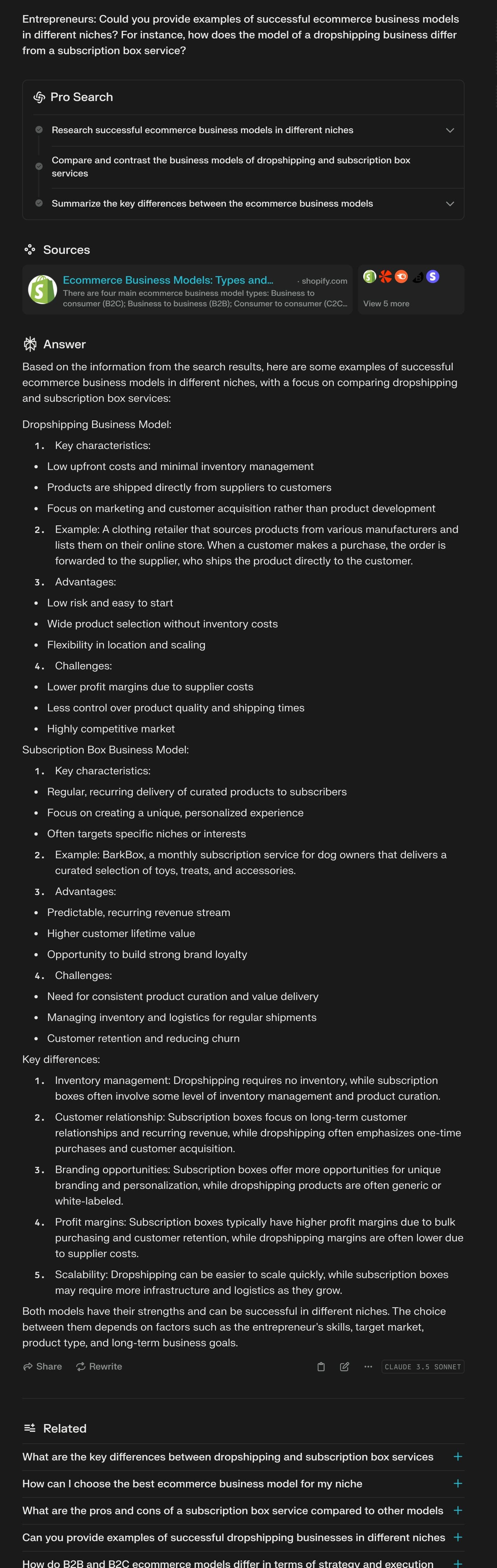
- Entrepreneurs: Could you provide examples of successful ecommerce business models in different niches? For instance, how does the model of a dropshipping business differ from a subscription box service?
- Content Creators: Can you give examples of how different types of content creators engage their audiences? For instance, how might a YouTuber’s engagement strategies differ from those of a podcaster?
- Product Managers: Could you provide examples of how successful SaaS products have integrated AI to improve user experience? Perhaps compare an AI-driven feature in a product like Grammarly to a more traditional SaaS offering.
Tested Entrepreneurs: Dropshipping vs Subscriptions Model in Perplexity.
Study Technique #2: Enhance recall with AI-generated mnemonics and memory aids
Quizzing yourself with the AI’s help reinforces the memory aids.
Marketing Managers
Concept: SaaS Customer Acquisition Cost (CAC)
Mnemonic: “SCALE” – Spend, Convert, Acquire, Leverage, Evaluate
Complex topic: Product-led growth in SaaS
Analogy: Think of product-led growth as a self-serve buffet where users can taste and experience the product before committing to a full meal (subscription).
Key facts: SaaS metrics (MRR, ARR, Churn, LTV)
Story: Imagine a garden where MRR is the daily growth, ARR the yearly harvest, Churn the weeds you must control, and LTV the total yield of a plant over its lifetime.
Business Leaders
Concept: Lean Startup Methodology
Mnemonic: “BUILD” – Begin with hypothesis, Understand customer needs, Iterate quickly, Learn from feedback, Develop MVP
Complex topic: Disruptive Innovation
Analogy: Think of disruptive innovation as a small stream gradually carving a new path through rock, eventually becoming the main river flow.
Key facts: Stages of startup funding (Seed, Series A, B, C)
Story: Imagine a tree growing from a seed (initial funding), developing strong roots (Series A), branching out (Series B), and finally bearing fruit (Series C).
Creatives
Concept: Principles of UI Design
Mnemonic: “CRAP” – Contrast, Repetition, Alignment, Proximity
Complex topic: User-Centered Design
Analogy: Think of user-centered design as tailoring a custom suit, measuring and adjusting at every step to ensure a perfect fit for the wearer.
Key facts: Stages of the Design Thinking process (Empathize, Define, Ideate, Prototype, Test)
Story: Imagine a detective solving a case: first understanding the victim (Empathize), identifying the problem (Define), brainstorming solutions (Ideate), creating a plan (Prototype), and finally catching the culprit (Test).
Entrepreneurs
Concept: Lean Canvas Model
Mnemonic: “PROBLEM” – Problem, Revenue, Offering, Benefit, Leverage, Expenses, Market
Complex topic: Network Effects
Analogy: Think of network effects as a snowball rolling down a hill, growing larger and gaining momentum as more snow (users) sticks to it.
Key facts: Startup growth stages (Problem/Solution Fit, Product/Market Fit, Scale)
Story: Imagine a chef perfecting a recipe (Problem/Solution Fit), opening a successful restaurant (Product/Market Fit), and finally franchising globally (Scale).
Content Creators
Concept: Content Marketing Funnel
Mnemonic: “AIDA” – Attention, Interest, Desire, Action
Complex topic: SEO Strategy
Analogy: Think of SEO as tending a garden, where keywords are seeds, content is the soil, and backlinks are the sunlight helping your garden grow and thrive.
Key facts: Key Performance Indicators for content (Views, Engagement, Conversion, Retention)
Story: Imagine a performer on stage, first catching the audience’s eye (Views), then keeping them entertained (Engagement), convincing them to buy tickets for the next show (Conversion), and finally creating loyal fans (Retention).
Product Managers
Concept: Agile Development Principles
Mnemonic: “FAST” – Flexible, Adaptive, Sprints, Team-oriented
Complex topic: Technical Debt
Analogy: Think of technical debt as taking a shortcut on a hike. It might save time now, but you’ll eventually have to backtrack and take the longer, proper path.
Key facts: Stages of Product Development (Ideation, Definition, Design, Development, Launch)
Story: Imagine an inventor creating a time machine: first dreaming up the idea (Ideation), figuring out how it works (Definition), drawing blueprints (Design), building the machine (Development), and finally taking the first trip (Launch).
Study Technique #3: Create Flashcards
Here are some prompts to generate flashcards with questions using AI for marketing, business and creative fields.
The objective is to get the AI to generate the questions and answers for the flashcards based on the key concepts you provide.
Specifying the number of flashcards helps keep the set focused and manageable.
Asking for examples and case studies helps make abstract concepts more concrete and memorable.
After generating the flashcards, importing them into an AI study tool like Quizlet, Anki or Brainscape makes it easy to study and review them using features like spaced repetition and active recall.
The flashcard creation process itself, guided by specific prompts, also helps reinforce the material.
Based on the provided search results and instructions, I’ll generate flashcards for the specified audiences: Marketing Managers, Business Leaders, Creatives, Entrepreneurs, Content Creators, and Product Managers. I’ll use the format and style suggested in the examples.
For Marketing Managers
- Q: What are the 4 main types of market segmentation?
1) Demographic (age, gender, income)
2) Psychographic (lifestyle, values)
3) Behavioral (purchase behavior, brand loyalty)
4) Geographic (location, climate)Example: A SaaS company might segment its market by company size (demographic) and industry (psychographic).
- Q: What are the key components of a SaaS marketing plan?
A: Customer Acquisition Cost (CAC), Customer Lifetime Value (LTV), Churn Rate, Net Promoter Score (NPS), and key channels like content marketing, SEO, and social media. - Q: What are the primary differences between B2B and B2C SaaS marketing strategies?
A: B2B marketing focuses on relationship building, longer buying cycles, and ROI-driven messaging. B2C marketing targets individual consumers with shorter buying cycles and emotional appeals. - Q: Explain the stages of the sales funnel (Awareness, Interest, Desire, Action) using a story.
A: Imagine a customer named Jane who needs a project management tool. In the Awareness stage, she sees an ad for a SaaS tool. In the Interest stage, she reads reviews and visits the website. In the Desire stage, she signs up for a free trial. In the Action stage, she subscribes to the service. - Q: What are 3 common digital marketing metrics and what do they measure?
A: 1) Conversion Rate: measures the percentage of visitors who take a desired action
2) Customer Acquisition Cost (CAC): measures the cost to acquire a new customer
3) Customer Lifetime Value (LTV): measures the total revenue expected from a customer over their lifetime
For Business Leaders
- Q: What are the 5 main components of a SWOT analysis?
A: Strengths, Weaknesses, Opportunities, Threats, and Trends - Q: What are the 4 key financial statements?
A: 1) Income Statement (shows profitability)
2) Balance Sheet (shows financial position)
3) Cash Flow Statement (shows cash inflows and outflows)
4) Statement of Shareholders’ Equity (shows changes in equity) - Q: What are 3 common business strategies and when to use them?
A: 1) Cost Leadership: used to become the lowest-cost producer
2) Differentiation: used to offer unique products
3) Focus Strategy: used to target a specific market segment - Q: Explain the main functions of management with a real-world example.
A: Planning: Setting goals (e.g., a startup planning its product launch timeline)
Organizing: Arranging tasks and resources (e.g., structuring company departments)
Staffing: Recruiting and training employees (e.g., hiring developers for a tech startup)
Directing: Leading and motivating employees (e.g., guiding a team through a project)
Controlling: Monitoring performance and making adjustments (e.g., tracking sales targets) - Q: What are the major decision areas in B2B startup operations?
A: Communication, Team Expectations, Process Documentation, Tech Integration, Transparency, Data-Driven Decisions, Feedback Collection, and Operations Ownership
For Creatives
- Q: What are the 7 basic principles of graphic design?
A: 1) Balance, 2) Alignment, 3) Hierarchy, 4) Contrast, 5) Rhythm, 6) Proximity, 7) Color and space - Q: What are the stages of the creative process?
A: 1) Preparation, 2) Incubation, 3) Illumination, 4) Implementation - Q: What is the importance of rhythm in design?
A: Rhythm brings together different elements to create a more organized and consistent look. It can be fluid (adding variation) or progressive (based on a clear sequence). - Q: How can contrast be used in design?
A: Contrast guides the customer’s attention to key elements and enhances legibility. It can be created through oppositions like dark vs light, thick vs thin, contemporary vs traditional, or large vs small. - Q: What is the role of proximity in design?
A: Proximity helps declutter the overall design by creating a relationship between related elements. It forms a visual connection among important design factors such as color, font, type, or size.
For Entrepreneurs
- Q: What are the key components of a successful ecommerce business model?
A: Product selection, target market identification, pricing strategy, fulfillment and shipping, customer service, marketing and advertising, and technology infrastructure - Q: What is the “Lean Startup Methodology”?
A: A business approach that emphasizes rapid experimentation, iterative product releases, and validated learning to reduce market risks and avoid the need for large amounts of initial funding - Q: What is “Product-Market Fit”?
A: The degree to which a product satisfies strong market demand, typically indicated by rapid sales growth and high customer retention rates - Q: What are the stages of startup funding?
A: Seed funding, Series A, Series B, Series C, and potentially further rounds or an IPO (Initial Public Offering) - Q: What is a “pivot” in the context of startups?
A: A significant change in business strategy based on feedback and learning, often involving a shift in product, target market, or business model
For Content Creators
- Q: What is the AIDA model in content marketing?
A: Attention, Interest, Desire, Action – a framework for creating content that guides the audience through the stages of engagement and conversion - Q: What is SEO and why is it important for content creators?
A: Search Engine Optimization – the practice of optimizing content to rank higher in search engine results, increasing visibility and organic traffic - Q: What are the key elements of storytelling in content creation?
A: Character, setting, conflict, plot, and theme – these elements help create engaging and memorable content - Q: What is the importance of a content calendar?
A: A content calendar helps plan, organize, and schedule content creation and publication, ensuring consistency and aligning with marketing goals - Q: What are some key performance indicators (KPIs) for content creators?
A: Views, engagement rate (likes, comments, shares), watch time, subscriber growth, and conversion rate
For Product Managers
- Q: What is the Agile methodology in product development?
A: An iterative approach to software development that emphasizes flexibility, customer feedback, and rapid delivery of working software - Q: What is a product roadmap?
A: A high-level visual summary that outlines the vision, direction, priorities, and progress of a product over time - Q: What is the difference between a MVP (Minimum Viable Product) and a MMP (Minimum Marketable Product)?
A: MVP is the most basic version of a product that can be released to gather user feedback, while MMP is the simplest version that delivers enough value for customers to purchase or use it - Q: What is user story mapping?
A: A visual exercise that helps product managers and their teams define the work that will create the most delightful user experience - Q: What is the role of analytics in product management?
A: Analytics help product managers make data-driven decisions by providing insights into user behavior, product performance, and areas for improvement
Study Technique #4: Explore real-world applications
Here, our goal is to create an interactive learning experience that goes beyond memorizing facts to developing practical skills and creative thinking abilities.
These prompts are designed to spark creative problem-solving and encourage learners to apply concepts to realistic scenarios.
The AI’s role is to engage in a back-and-forth discussion, providing relevant examples, asking probing questions, and collaborating with the user to generate novel ideas and solutions.

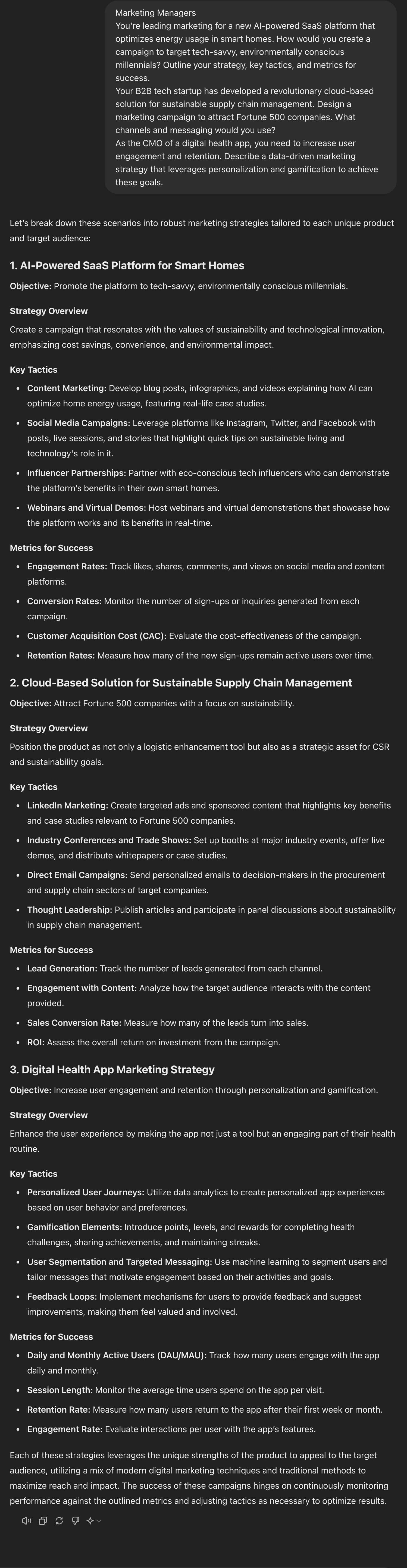
For example, in the first marketing prompt, the AI might share a case study of a successful eco-friendly product launch, highlight key strategies used, and then brainstorm with the user on how to adapt those tactics for the smart home context.
AI can offer suggestions, critique ideas, and help refine the campaign plan.
The prompts below will trigger more ideas to experiment with. Use them one at a time, in the chatbot.
Marketing Managers
- You’re leading marketing for a new AI-powered SaaS platform that optimizes energy usage in smart homes. How would you create a campaign to target tech-savvy, environmentally conscious millennials? Outline your strategy, key tactics, and metrics for success.
- Your B2B tech startup has developed a revolutionary cloud-based solution for sustainable supply chain management. Design a marketing campaign to attract Fortune 500 companies. What channels and messaging would you use?
- As the CMO of a digital health app, you need to increase user engagement and retention. Describe a data-driven marketing strategy that leverages personalization and gamification to achieve these goals.
Business Leaders
- You’re the CEO of a manufacturing company transitioning to sustainable practices. How would you communicate this shift to stakeholders and position it as a competitive advantage? Outline your strategy and expected outcomes.
- As an investor, you’re evaluating a promising B2B startup in the renewable energy sector. What key factors would you consider in assessing its market potential and scalability?
- Your B2C electronics company is facing increased competition. Develop a strategy to differentiate your brand through innovative product features and customer experience. How would you measure its success?
Creatives
- You’re a UI/UX designer tasked with reimagining the interface for a popular music streaming app. How would you incorporate elements of synesthesia to create a more immersive listening experience?
- As a sculptor, you’ve been commissioned to create a public art installation that changes with the seasons. Describe your concept and how it would engage viewers throughout the year.
- You’re part of a team designing a virtual reality art gallery. How would you translate traditional artistic elements into an interactive, digital experience?
Entrepreneurs
- You’re launching an ecommerce platform that connects local artisans with global markets. How would you build trust with both sellers and buyers? Outline your strategy for scaling the business.
- Your tech startup has developed an AI-powered personal finance assistant. How would you position this product in the market and what key partnerships would you pursue to accelerate growth?
- As a small business owner, you’ve created a line of sustainable fashion accessories. Develop a strategy to compete with larger brands and carve out a niche in the market.
Content Creators
- You’re a YouTuber specializing in tech reviews. How would you create a series that explores the environmental impact of popular gadgets without alienating your audience?
- As a podcaster, you want to launch a show about entrepreneurship in emerging markets. How would you structure the series and what unique angle would you use to stand out in a crowded field?
- You’re a video producer tasked with creating a viral campaign for a new plant-based food product. Describe your concept and distribution strategy across multiple platforms.
Product Managers
- You’re leading the development of a new AI-powered productivity app. How would you integrate machine learning to personalize the user experience while respecting privacy concerns?
- Your SaaS company is expanding into a new market segment. How would you adapt your product strategy to meet the needs of this audience while maintaining your core value proposition?
- As a product manager for a smart home device, you need to improve user adoption and reduce churn. Outline a strategy that leverages data analytics and user feedback to drive product improvements.
Tested Marketing Managers, AI powered SaaS platform in ChatGPT 4 Plus.
Study Technique #5: Engage in adaptive quizzes
The goal here is to get AI to generate a bank of questions on a topic, or subject.
- Step 1: Copy the 3 questions, say for Marketing below, into the chatbot.
Use this query: Given below is a seed list of questions. I want to expand these questions to 10, in similar vein. - Step 2: Query – Expand Question 1, 2, 3 with detailed descriptions.

Marketing Managers
- What are the key differences between inbound and outbound marketing strategies for SaaS companies?
- How would you use social media platforms to launch a new B2B tech product targeting millennial decision-makers?
- What metrics would you track to measure the success of an email marketing campaign for a SaaS startup?
- How can content marketing be leveraged to generate leads for a B2B tech company?
- What are the most effective customer acquisition channels for a B2C digital service?
- How would you structure a freemium model for a SaaS product to maximize conversions?
- What strategies can be used to reduce customer churn in a subscription-based tech service?
- How would you design a referral program for a B2B SaaS platform?
- What are the key components of an effective account-based marketing strategy for enterprise tech sales?
- How can marketing automation be used to nurture leads in a long B2B sales cycle?
Business Leaders
- How can a manufacturing company use data analytics to gain a competitive advantage in its industry?
- What are the most important factors to consider when conducting a SWOT analysis for a B2B startup?
- How would you apply the principles of lean management to improve a manufacturing process?
- What key metrics should investors focus on when evaluating a B2C tech startup?
- How can a B2B company effectively transition from a product-centric to a customer-centric business model?
- What strategies can be employed to scale a B2C startup while maintaining product quality and customer satisfaction?
- How would you approach international expansion for a B2B manufacturing company?
- What are the critical components of a successful digital transformation strategy for a traditional manufacturing business?
- How can business leaders foster a culture of innovation in a B2B startup environment?
- What risk management strategies should be implemented when launching a new product in the B2C market?
Creatives
- What techniques can be used to overcome creative block when designing a new UI/UX interface?
- How can color psychology be applied in graphic design to evoke specific emotions in a branding project?
- What are the key elements of effective storytelling in a short promotional video for a tech product?
- How would you incorporate principles of sculpture into a 3D user interface design?
- What strategies can photographers use to capture the essence of a tech product in a visually compelling way?
- How can principles from performing arts be applied to create more engaging user experiences in digital products?
- What are the best practices for creating accessible designs in UI/UX for users with disabilities?
- How would you approach designing a cohesive visual identity system for a multi-platform digital service?
- What techniques can be used to effectively communicate complex data through infographic design?
- How can AR/VR technologies be integrated into traditional art forms to create immersive experiences?
Content Creators
- What is the primary goal of content marketing?
- How would you use storytelling techniques to make your content more engaging for your target audience?
- What are the key elements of an effective content strategy for a YouTube channel?
- How can SEO be leveraged to increase the visibility of blog posts?
- What metrics would you track to measure the success of a podcast?
- How would you repurpose a long-form blog post for social media platforms?
- What are the best practices for creating accessible content for users with disabilities?
- How can data analytics be used to improve content performance?
- What strategies would you employ to build and engage a community around your content?
- How would you approach creating content for a new platform or format you’re unfamiliar with?
Entrepreneurs
- What are the key components of a lean startup methodology?
- How would you validate a business idea before investing significant resources?
- What strategies can be used to bootstrap a startup with limited funding?
- How would you approach finding and securing the right investors for your venture?
- What are the most important factors to consider when scaling an ecommerce business?
- How can data analytics be leveraged to make informed business decisions?
- What are the key elements of an effective pitch to potential investors or partners?
- How would you build and manage a remote team for a digital startup?
- What strategies can be employed to protect intellectual property in a tech startup?
- How would you approach international expansion for a small business?
Product Managers
- What is the difference between a product roadmap and a product backlog?
- How would you prioritize features for a new SaaS product?
- What techniques can be used to gather and analyze user feedback effectively?
- How would you measure the success of a newly launched product feature?
- What are the key considerations when integrating AI into an existing product?
- How can agile methodologies be applied in product management?
- What strategies would you use to align stakeholders with different priorities?
- How would you approach sunsetting a product or feature?
- What are the best practices for conducting user research for a B2B SaaS product?
- How can product managers effectively collaborate with UX designers and developers?
Study Technique #6: Check for gaps
This is a very interesting, interactive technique where we share our study material, or for that matter anything we have already written, with the chatbot and then ask it to review it and suggest ways to improve it.
The Prompt
[Modify this as needed and use any one of the suggestions below]
Given below is an outline of an article that I have written on marketing segmentation.
- Review this critically, enhance it, add missing elements and recraft
- Suggest examples, explanations, or use cases
- Quiz me on the content and discuss weak areas
- Revise the outline based on all the suggestions by you
<insert your text>
- Marketing Managers: Imagine your marketing plan is a gourmet meal. What key ingredients are missing from this recipe for success? Let’s spice it up and make it irresistible to your target audience!
- Business Leaders: Your business analysis is like a treasure map, but are we missing any X marks the spot? Let’s uncover hidden gems of insight that could lead to untold riches!
- Creatives: Your creative process explanation is a masterpiece, but could it use a splash more color? Let’s paint a vivid picture that even a five-year-old could understand!
- Entrepreneurs: Your business model canvas is like a blueprint for success, but are we missing any load-bearing walls? Let’s architect a foolproof plan that even gravity can’t bring down!
- Content Creators: Your content strategy is a blockbuster in the making, but are we missing any plot twists? Let’s script a narrative so engaging, even binge-watchers will be impressed!
- Product Managers: Your product roadmap is like a journey to the moon, but are we missing any crucial pit stops? Let’s plan an odyssey that would make even Neil Armstrong jealous!
Study Technique #8: Master problem-solving
Marketing Managers
- If your SaaS product was a superhero, what would its origin story be?
- Imagine your B2B tech solution is a guest at a Silicon Valley dinner party. How would it introduce itself?
- Create a haiku that captures the essence of your startup’s disruptive mission.
- If your digital marketing strategy was a recipe, what cutting-edge ingredients would you need?
- Write a breakup letter from your enterprise customer explaining why they’re switching to your cloud-based solution.
Business Leaders
- If your B2B startup was a character in a classic business case study, which one would it be and why?
- Imagine your manufacturing company is hosting a TED Talk on innovation. What would the topic be?
- Create a playlist that represents your startup’s journey from seed funding to IPO.
- If your business model was a game of 3D chess, what would be your disruptive opening move?
- Write a tweet from the year 2050 about your company’s biggest impact on sustainable manufacturing.
Creatives
- If UI/UX trends had personalities, which one would best represent your design philosophy?
- Imagine you’re a time-traveling sculptor. What future era would you visit for inspiration?
- Create a six-word memoir that sums up your journey as a digital artist.
- If your creative block in graphic design was a physical obstacle, what would it look like and how would you overcome it?
- Write a review of your latest UI project from the perspective of a user in 2040.
Entrepreneurs
- If your ecommerce platform was a character in a tech startup fable, which one would it be and why?
- Imagine your digital business is pitching to a panel of AI investors. What would your 30-second elevator pitch be?
- Create a roadmap that visualizes your tech startup’s journey from MVP to market domination.
- If your business model was a virtual reality game, what would be the first challenge players need to overcome?
- Write a press release from 2030 announcing your small business’s revolutionary impact on the gig economy.
Content Creators
- If content formats were characters in a streaming series, which one would be the protagonist of your channel?
- Imagine you’re a time-traveling YouTuber. What past era would you vlog about to gain millions of views?
- Create a six-word story that encapsulates the essence of your podcast’s mission.
- If writer’s block was a boss in a video game, what special move would you use to defeat it?
- Write a review of your latest viral video from the perspective of a Gen Alpha viewer in 2035.
Product Managers
- If your AI-powered app was a character in a sci-fi novel, what would its prime directive be?
- Imagine your SaaS product is explaining its value proposition to a skeptical legacy system. How would the conversation go?
- Create a user story map that represents your digital service’s evolution from beta to industry standard.
- If your product development process was a strategy game, what would be your winning end-game scenario?
- Write a case study from 2040 about how your current product revolutionized its industry.
AI Tools that you can use
The prompts on Phewture are AI tool agnostic.
They should work on GeminiPro, ChatGPT, Claude and Perplexity. Even on free tools such as llama3 by Meta which you can install on your desktop.
- ChatGPT and Gemini Pro can read Google Files by way of attachment
- Claude can read PDFs.
- Perplexity can read text files and PDFs.
Use these capabilities to upload your prompts and get the best out of these tools.
You will have to use the following prompt, if you follow the file upload method: Please complete the tasks outlined in the attached document.
Next Steps
- To help you find your way around Phewture, I have put together a set of articles under Wayfinding. Do go through these and you’ll navigate like a pro through this stream of consciousness. 😄
- The Learning Methods are unique exercises that I’d recommend if you wish to wrap your head around the possibilities of AI at work, or play.
- Don’t forget to leave your comments below and share your joy with your friends on social media. Use the share icons below this post to gain some good karma.
- Wish to train your in-house team on AI techniques and raise their productivity by 5X, and creativity by 10X?
Phewture offers AI-spurred training for teams and brands. Do check out the Training Services.
While you enjoy your sojourns here do give me your feedback. Use the comment box below and let it rip.